Summer Workers’ Comp Investigations: Documenting the Facts
Key Takeaways
Through this article, workers’ comp adjusters can find out:
- How summer workers’ comp investigations could help adjusters obtain facts about potentially questionable claims
- The benefits that remote camera deployments, in-person surveillance, and social media investigations can bring to the fact-verification process
- How licensed investigators provide adjusters with unbiased reports that will allow them to resolve claims with the facts in hand
Summer travel and outdoor events could become opportunities to verify claim details when adjusters are handling workers’ compensation claims that raise questions.
Insurance professionals can turn to their investigative partner for remote camera deployments, in-person surveillance, social media investigations, or a combination thereof, to gather evidence during these periods.
Types of Workers’ Comp Claim Investigations To Consider During Summer
After deciding to refer a claim for additional fact gathering, insurance professionals and investigators will work together to decide how to obtain evidence most effectively and efficiently. This decision will be unique to each claim and the details that need to be verified.
Social Media Investigations
In many situations, a social media investigation could be a solid first step. These checks can include reviewing publicly available online profiles in accordance with legislation and industry guidelines to verify whether the claimant’s lifestyle and activity align with claim details.
For instance, an investigator might acquire public images or video uploaded during or immediately following a claimant’s vacation. The footage may show a claimant, who allegedly suffered a broken leg at work, walking on a beach either in a cast or without apparent ambulatory restrictions.

Social media investigations can identify and preserve publicly available, time-stamped content that adjusters may consider when evaluating claim information. Such details should only be obtained through lawful and approved channels.
These time-stamped images, videos, or text posts, which should be documented via screenshots or downloads and in accordance with procedure or protocols, can help verify the reported timeline of events and extent of claimed injury or physical limitation. Posts that include location tags or event-specific hashtags may also help assess a person’s location.
Investigators could also review relevant publicly available content associated with known social connections while remaining within applicable laws, client guidelines, and approved investigative practices. However, adjusters should confirm that their investigative partner is aware of local laws and industry standards and conducts online searches accordingly. Investigators should not create fake profiles or use personal accounts to access private information.
Depending on the complexity of the claim, digital evidence gathering may be sufficient for the adjuster to make a determination. However, more complex claims could require a full-scope surveillance effort that includes in-person surveillance, remote camera deployments, or both.
Surveillance Methods
Summer workers’ comp investigations could lend themselves to one or more types of surveillance. Warm weather tends to draw people into public view for outdoor events such as plays or concerts, summer sports, or personal travel.
Remote camera deployments can provide a discreet and cost-effective method of documenting activity at predetermined locations, as well as determining potential departure routes. Meanwhile, in-person surveillance offers the flexibility to document activity and movement across multiple locations. Third-party footage could also prove useful.
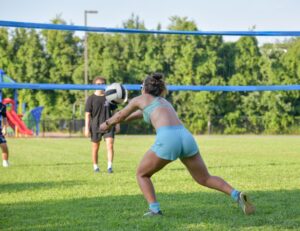
Claim investigations could include in-person surveillance at public gathering spaces, such as parks, to validate claim details.
For example, these methods could document a claimant playing volleyball in a public park after reportedly suffering a back injury in a work-vehicle crash.
Remote camera deployments may be more appropriate if:
- The surveillance environment is more challenging, such as in a remote area
- The claimant is “surveillance aware” and could recognize a surveillance vehicle
Remote cameras must be positioned and operated from legally permissible locations and should not capture areas where individuals have a reasonable expectation of privacy. Deployments near medical facilities require additional review because of heightened privacy and sensitivity concerns.
In-person surveillance might prove more fruitful if:
- Shifting between photographic and video evidence would improve evidence gathering
- Adapting to changes in the claimant’s patterns of behavior is necessary
Additional details may be available from third-party footage if:
- The claimed injury occurred in a vehicle collision and dash or body camera video recordings from law enforcement can substantiate incident details
- Security cameras from businesses or entities near the incident location captured the activity preceding or following the claimed event
- Traffic or security camera footage, possibly from a public park or high-volume roadway, might have documented the claimant’s movements over a long holiday weekend
Insurance professionals can discuss these options with their investigative partner and begin building a claim referral package with the information they have already obtained and the inconsistencies they want to verify.
Partnering With a Licensed Investigator
Carriers seeking an opportunity to verify claim details during popular summer travel periods or outdoor festivities could benefit from referring questionable workers’ comp claims to an investigative team.
Licensed investigators have the expertise to gather evidence within legal parameters, ethical best practices, and industry guidelines, freeing up busy adjusters to work on other claims while fact documentation is occurring.
Using initial information, investigators partner with the adjuster to build a strategy to document evidence most effectively during periods of increased activity. Their observations are then compiled into an objective report an adjuster can use to inform their claim decision.
VRC Investigations, a single-source solution for investigative, SIU, and regulatory compliance needs and part of Alpine Intel’s suite of services, has a team of skilled investigators who are prepared to deliver comprehensive reports that confirm claim details, address potential misrepresentation, and enable clients to make confident and timely decisions. Submit an assignment today.

Don’t miss insurance-focused resources and webinars about property, perils, and trends impacting claims nationwide by signing up for The Savvy Adjuster Newsletter.

Be sure to also tune in to The Savvy Adjuster Podcast to hear more from the experts themselves.
Alpine Intel’s content is meant to inform and educate readers using general terms and descriptions. They do not replace expert evaluations that determine facts and details related to each unique claim.
Related Resources

Workers’ Comp Investigations: The Role of Surveillance
Learn when to employ surveillance in workers’ comp investigations, best practices for doing so, and how the right investigative partner can help.
Workers’ Compensation Claim Investigations eBook: An Adjuster’s Guide to Identifying Potential Misrepresentation
Read this eBook to learn about workers’ compensation claim misrepresentation and how investigative partners help adjusters verify facts if questions arise.
Workers’ Compensation Claim Investigations eBook: An Adjuster’s Guide to Identifying Potential Misrepresentation
Read this eBook to learn about workers’ compensation claim misrepresentation and how investigative partners help adjusters verify facts if questions arise.