What Makes Industrial Fire Losses So Complex?

Key Takeaways
Insurance and legal professionals will read about:
- Industrial facility fire hazards and specialized equipment
- The stakes that make industrial fire losses different from smaller residential or commercial fires
- Why coordinated investigations and multiple types of experts may be needed
Industrial and manufacturing structure fires caused an estimated $988 million in property damage each year from 2017–2021, according to the most recent data from the National Fire Protection Association (NFPA).
In addition to their financial impact, these losses often involve unique fire hazards, specialized equipment, a variety of stakeholders, and the potential for subrogation or litigation. Here’s what insurance and legal professionals should consider as they work to address industrial fire losses.
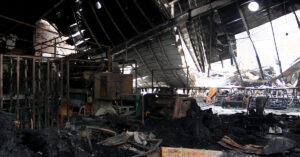
Industrial fire investigations often require certified fire investigators to examine complex equipment, hazardous materials, and facility operations to determine how a fire began.
Unique Industrial Fire Hazards
Equipment or heat source failures were the leading cause of structure fires in industrial and manufacturing properties from 2017–2021 and accounted for 43% of direct property damage, according to the NFPA.
Industrial facilities often contain specialized equipment, such as industrial ovens, furnaces, conveyor systems, and hydraulic presses. When this equipment overheats, malfunctions, or is improperly installed, maintained, or operated, it can create conditions that lead to significant fire losses.
Part of a certified fire investigator’s role is to identify all potential ignition sources at a scene and use the available evidence to develop and test hypotheses about how the fire started. When evidence indicates that equipment may have been involved in the fire’s ignition or development, additional expertise may be needed to identify the possible failure mode. In these cases, electrical or mechanical engineers can participate in joint investigations to help determine how and why the equipment failed.
During an industrial fire investigation, certified fire investigators may also need to consider whether any of the following fire hazards contributed to the loss:
- Hot Work: Welding, torch cutting, brazing, soldering, heating, and burning can generate sparks or open flames capable of igniting nearby combustible materials.
- Combustible Dust: Metal dust and sawdust, which are often produced during manufacturing processes, can ignite or explode when they accumulate and come into contact with an ignition source.
- Flammable Liquids and Gases: Substances such as diesel fuel and gasoline may be on-site and can accelerate fire growth.
- Operational Hazards: Improperly performed procedures, inadequate safety measures, or other human involvement could also be factors in industrial fires.
Investigators may also need to evaluate the fire suppression systems intended to mitigate these hazards. Inspections can determine whether these systems functioned as designed and what role they played in stopping—or failing to stop—the spread of the fire. A Certified Fire Protection Specialist (CFPS) can perform this kind of evaluation and help insurers or legal professionals understand whether these systems were serviced and maintained in accordance with federal, state, or local regulations.
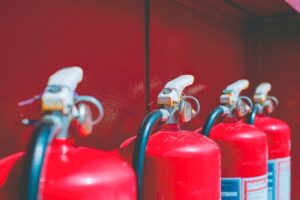
If fire suppression systems fail to contain an industrial fire, determining whether they functioned as designed can be an important part of the investigation.
Larger Fire Losses Mean Larger Investigations
As touched upon, the costs and consequences associated with an industrial fire can be immense. Personnel, equipment, structures, vehicles, or inventory may be impacted.
With that potential scale of loss comes a lot of stakeholders; these may include carriers, equipment manufacturers, property owners or management companies, fire departments, engineers, and attorneys. Many of these parties or their representatives may need to be present for joint investigations. It’s important that these are properly coordinated. From the outset, protocols should be established to protect everyone entering the scene and to preserve potential evidence.
Engaging a fire investigators early—and ensuring they can respond quickly—is also critical when navigating large industrial fire investigations. A team that can determine urgent needs, help secure the scene, and efficiently coordinate responsibilities can establish a strong foundation for the entire investigation.
Industrial Fire Investigations May Not End at the Scene
On-site investigations may be only one part of the process. When equipment is determined to have contributed to a fire, investigators or engineers may recommend transporting it to a laboratory for additional testing. The examination can provide additional data for evaluating possible failure modes, installation or maintenance issues, product conditions, and other hypotheses. If carriers or attorneys choose to pursue this testing, the findings can help them to further evaluate subrogation opportunities.
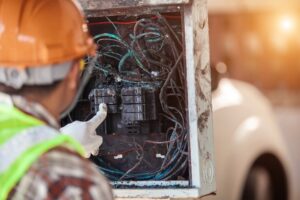
Electrical and mechanical engineers often participate in joint fire investigations and sometimes recommend further laboratory testing.
However, transporting evidence introduces another challenge: maintaining its integrity. NFPA 921 provides guidance for maintaining the integrity and chain of custody of physical evidence throughout its handling. Evidence should be properly identified, packaged, protected, transported, and stored to preserve its condition and integrity. A documented chain of custody should record each transfer of evidence and who received it. Limiting unnecessary transfers can reduce the risk of loss, contamination, or an undocumented break in custody. This record, along with the preserved evidence, can minimize legal challenges should the loss require subrogation or become the subject of litigation.
Why a Coordinated Industrial Fire Response Matters
The complexity of an industrial fire leaves little room for delays or a fragmented response. With many unique fire hazards, specialized equipment, interested parties, and legal considerations, it’s important to act swiftly and effectively.
An experienced investigation team can rapidly secure the scene, document conditions before they change, identify immediate investigative needs, and develop a coordinated plan that helps preserve the information needed to accurately determine the fire’s origin and cause.
For these complex losses, carriers and legal professionals can rely on the National Fire Experts (NFE) Large Loss Response Team. Under Alpine Intel, this team operates as a network of in-house certified fire investigators, engineers, and other experts who can help answer client questions about the loss faster. Through Donan’s Component Testing Laboratories, also part of Alpine Intel, clients can access evidence management services and science-based product failure insights to inform subrogation decisions. For losses that progress to legal proceedings, our experts are equipped to serve as expert witnesses.
Submit an assignment to National Fire Experts for a coordinated fire investigation you can depend on.
Engineering services are provided by or subcontracted to Donan Engineering, LLC, Donan Engineering NC, PLLC, or Donan Forensic, LP. National Fire Experts performs work in Indiana under Donan Engineering license PI20700047.

Don’t miss insurance-focused resources and webinars about property, perils, and trends impacting claims nationwide by signing up for The Savvy Adjuster Newsletter.

Be sure to also tune in to The Savvy Adjuster Podcast to hear more from the experts themselves.
Alpine Intel’s content is meant to inform and educate readers using general terms and descriptions. They do not replace expert evaluations that determine facts and details related to each unique claim.
Related Resources

Agricultural Fire Losses Guide
Prepare for agricultural fire losses with this guide on equipment that’s often involved, common fire hazards, and potential subrogation considerations.
Your Guide to Investigating Manufacturing and Industrial Fire Losses
Learn about common factors and challenges in industrial fire losses and read about the benefits of using certified investigators with this guide.
Case Study: Industrial Fire Investigation
A fire at a manufacturing facility led to a complex claim and left the carrier in need of details about the ignition sequence. That’s where National Fire Experts stepped in to help.