
How To Verify Cause of Loss for Claimed Earthquake Damage to Houses

Key Takeaways
Throughout this article, adjusters can find out:
- How earthquakes can cause structural damage
- Other causes of damage that may be claimed as earthquake damage
- How forensic engineering assessments give adjusters confidence in their claim decisions
Damaging earthquakes could affect nearly 75% of the United States, according to the latest seismic hazard model from the United States Geological Survey (USGS). But when it comes to property claims, confirmation of seismic activity doesn’t necessarily equal cause of loss.
Insurance professionals should understand what is commonly misattributed as earthquake-related damage, how to identify true indicators of seismic loss, and how forensic engineers use geological data to verify cause of loss. This science-based information provides adjusters with the information they need to resolve claims accurately and with confidence.
An Earthquake Occurred—But Is It Really the Cause of Loss?
Policyholders may experience a small earthquake or see news coverage of an earthquake in their area, leading them to check their home for damage. In doing so, they could inadvertently attribute pre-existing structural damage to the event. This is why forensic engineers are vital to the claim resolution process. They consider the following characteristics to verify cause of loss for adjusters.
Lack of Severity
Earthquakes are measured by intensity (extent of shaking), which decreases as it gets farther from an earthquake’s epicenter. So even if geographical and topographical data confirm seismic activity, it may not be forceful enough at a specific property to cause the claimed damage.
For example, one of Donan Engineering’s licensed forensic engineers was tasked with determining the cause of drywall cracks in a manufactured home. The policyholder reported noticing the cracks after they believed their house was affected by an earthquake, but no household items were displaced or had fallen over.
The engineer confirmed through the Center for Earthquake Research and Information and the USGS that the largest earthquake reported within 200 miles of the property had a 4.2 magnitude and occurred on the claimed date of loss. Its epicenter was about 17 miles northeast of the property and reportedly 8 miles deep.
A USGS ShakeMap review determined that the loss location was in the Level III zone, which is considered weak with a potential damage category of “none.” The lack of damage inside the home and to exterior walls also indicated an earthquake did not cause the damage.
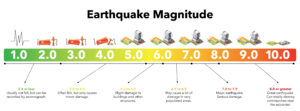
An earthquake’s magnitude determines its likelihood to inflict structural damage on a home or other structures. Source: Michigan Technological University
Distance From the Earthquake
In general, the farther a structure is from the epicenter, the less intense the shaking. In this previously noted case, only minimal damage would be expected at the epicenter, and this structure was too far from the epicenter to experience shaking to cause the reported damage, as indicated by the ShakeMap.
In another example, an adjuster assigned a Donan licensed forensic engineer to determine the cause of a shifting house. They reviewed USGS data within 200 miles of the property, covering a roughly two-and-a-half-month timeframe. No earthquakes with a magnitude exceeding 2.5 were recorded. About 250 miles northwest of the residence, a 6.4 magnitude earthquake was recorded in the same timeframe, but a USGS ShakeMap showed no potential for structural damage and that no shaking was felt. Taking this information into account and conducting a thorough on-site assessment, the engineer determined the shifting was caused by differential settlement and wood decay rather than an earthquake.
No Earthquake Occurred
Some property claims may unintentionally cite an earthquake as the cause of loss when none occurred. There may have been a construction blast or another event that felt like seismic activity, causing the policyholder to misattribute it.
Forensic engineers not only review weather and seismic data but also look at the claimed earthquake damage in the context of the entire structure; the whole property, including yards, fencing, or other elements; and the surrounding neighborhood. If there are no collateral indicators, such as fallen objects, something else could have caused the damage.
Issues related to soil quality and differential settlement can also cause cracks, shifting foundation, or other losses that a policyholder may believe resulted from an earthquake.
Licensed forensic engineers can provide adjusters with the information needed to determine if another cause of loss led to the damage or if it was, in fact, from an earthquake.
How Earthquakes Can Cause Structural Damage
Structures that are too weak or too rigid to withstand strong shaking forces that accompany an earthquake could sustain collateral and structural damage. This might occur through ground shaking, fault rupture, landslides, liquefaction, or other means, depending on the structure’s stability before the seismic activity and the loss location’s geographical landscape.
Unreinforced masonry buildings, or those that were inadequately constructed, weakened from age or rot, or built on soft or unstable soil, are more susceptible to earthquake damage.
Collateral indicators include:
- Damaged gypsum board
- Cracks at window and door corners
- Fragile items (pictures, dishes) have fallen off shelves or walls

Collateral damage that may suggest an earthquake occurred includes displaced or broken wall hangings, pictures, or shelving.
Meanwhile, structural damage such as cracks, breaks, and shifts to walls, foundations, or framing may indicate earthquake-related structural damage, so long as it can be corroborated with earthquake data.
When reviewing an earthquake damage claim, adjusters should partner with a forensic engineer who considers collateral and structural damage during their assessment. This will ensure the most accurate evaluation and give the adjuster the necessary information to make a confident claim decision.
How Forensic Engineers Determine Cause of Loss
Licensed forensic engineers use the scientific method to evaluate earthquake damage, much like any other claimed cause of loss. But what’s unique is how they approach the research side of their assessment.
They use unbiased, objective sources such as the USGS to confirm the following elements of seismic activity:
- Magnitude
- Distance of the structure from epicenter of the earthquake
- Intensity of shaking at a specific location
- Soil type and conditions
They may also use information from the policyholder, satellite imagery, local news outlets, and state or county property records to determine the integrity of the structure before the reported earthquake and how that might have influenced the extent of claimed damage.
Some engineers even hold earthquake assessment certification, making them uniquely qualified to evaluate this loss type. Donan Engineering has more than 100 licensed forensic engineers who hold the California Earthquake Authority (CEA) Residential Earthquake Damage Assessment (REDA), which ensures they are able to accurately assess any damage thought to have been caused by seismic activity.
Providing engineering services for more than 75 years, Donan Engineering is equipped to answer complex and challenging questions about property damage. Our licensed engineers offer definitive insights into the underlying cause of loss, including during earthquake damage assessments, delivering actionable intelligence through peer-reviewed reports. Submit an assignment today.
*Editor’s note: Engineering services are provided by or subcontracted to Alpine Intel Commercial Solutions, LLC, Alpine Intel Commercial Solutions, PLLC, Donan Engineering, LLC, Donan Engineering NC, PLLC, Donan Forensic, LP, BSC Forensic Services, LLC, or BSC Experts, PLLC.

Don’t miss insurance-focused resources and webinars about property, perils, and trends impacting claims nationwide by signing up for The Savvy Adjuster Newsletter.

Be sure to also tune in to The Savvy Adjuster Podcast to hear more from the experts themselves.
Alpine Intel’s content is meant to inform and educate readers using general terms and descriptions. They do not replace expert evaluations that determine facts and details related to each unique claim.
Related Resources
Key Indicators of Flood Damage
Dive into how different forces may impact properties during flood events, common damages, and how experts differentiate between flood damage and other causes of loss.

Water Damage in Property Loss Claims Guide
Water damage is a frequently claimed peril. Download this guide to learn more about water losses to HVAC systems and electronics, including critical data, causes, and affected items.
How Sump Pump Failures Can Cause Widespread Damage
Discover how consequences of sump pump failures can extend beyond the pump to appliances, HVAC equipment, and structural components.