
Why Adjusters Need Engineers with Earthquake Assessment Certification

Throughout this article, adjusters can find out:
- The benefits of partnering with an engineer who has earthquake assessment certification
- How the certification enhances the engineer’s knowledge and capabilities
- What types of damage are commonly claimed following a reported earthquake and how forensic engineers verify cause of loss
Earthquake damage costs the United States on average nearly $15 billion annually, according to the U.S. Geological Survey and the Federal Emergency Management Agency. When adjusters receive property claims following reported seismic activity, they need licensed engineers who are certified in assessing earthquake-related damage to ensure their claim decisions are based on an accurate cause of loss.
This FAQ explores how uniquely certified engineers bring more certainty to their post-earthquake assessments, the types of damage that are mistakenly attributed to earthquakes, and what earthquake damage assessments involve.
What Advantages Are There to Partnering With a Forensic Engineer Who’s Certified To Assess Earthquake Damage?
Forensic engineers who have obtained earthquake assessment certification are aware of the latest guidelines and building codes related to earthquakes, making them better equipped to:
- Evaluate common earthquake vulnerabilities and damage potential
- Identify, document, and evaluate earthquake-related damage
- Develop a scope of repair for earthquake-related damage
This knowledge informs their assessments and helps them determine if the claimed damage was due to an earthquake or another cause of loss.
Because certifications require periodic renewal, these professionals remain up to date on scientific research and constantly evolving industry best practices.
Just remember, cause-specific certifications are in addition to proper state-specific licensure.

Earthquake damage assessment certification gives licensed forensic engineers additional credibility when tasked with conducting an evaluation for a claim that cites seismic activity as the cause of damage.
What Certification Should I Ask if the Engineer Has Obtained?
The California Earthquake Authority (CEA) Residential Earthquake Damage Assessment (REDA) is the most common certification. It’s applicable nationwide*, despite originating in California.
Engineers who complete this certification should have a solid understanding of the Earthquake Damage Assessment and Repair Guidelines for Residential Wood-Frame Buildings, Volume 2 – Engineering Guidelines, which focus on damage commonly seen in one- and two-family wood-frame structures. This publication replaced the now-defunct Consortium of Universities for Research in Earthquake Engineering (CUREE) Guidelines in 2020.
The most recent guidelines, according to the Applied Technology Council, “increase the efficiency, consistency, and reliability” of earthquake-related assessments.
More than 100 of Donan Engineering’s licensed forensic engineers hold this certification nationwide*.
How Can Earthquakes Damage Structures?
Earthquakes can cause collateral and structural damage. Collateral indicators may include damaged gypsum board or cracks at window corners. Structural damage presents as cracks, breaks, or shifts to walls, framing, and foundations. This can occur if a structure is too weak or too rigid to resist strong shaking forces. Resulting movement may also lead to broken windowpanes and damage to unreinforced masonry chimneys, among other sensitive areas.
The CEA REDA certification extensively covers possible structural damage and related patterns that result from earthquakes. This gives engineers who hold the certification the necessary knowledge to distinguish damage before they even begin an assessment.
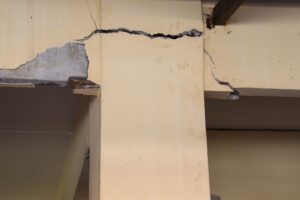
Structures that can’t withstand the force or movement of an earthquake could sustain cracks to walls or framing elements.
What Types of Damage Might Be Mistakenly Reported As Caused by an Earthquake?
Policyholders may report that an earthquake caused broken pipes, shifting foundation, wall cracks, or other non-functional issues. An assessment from an engineer with earthquake damage assessment certification can determine if the reported cause of loss is accurate or if it was actually due to differential settlement unrelated to an earthquake, age-related deterioration, normal shrinkage, or another reason.
In many cases, an earthquake may have occurred but was either too far away, or the seismic activity wasn’t severe enough to cause the reported damage. Policyholders inspecting their homes after an earthquake may also notice historical damage for the first time and inadvertently associate it with the seismic event.
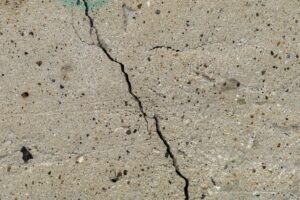
A licensed forensic engineer with earthquake damage assessment certification can determine if cracks to concrete were the result of seismic activity or if they were caused by something else.
How Do Engineers Assess Structural Damage for Earthquake-Related Claims?
Forensic engineers approach claimed earthquake damage the same way as any other assessment—by adhering to the principles of the scientific method, documenting their unbiased observations, and looking at the whole structure instead of just the area with reported damage.
They also conduct extensive geological data research to confirm whether an event occurred at or near the property and, if so, at what magnitude. This includes determining the earthquake’s magnitude and depth and the structure’s distance from the epicenter of a confirmed earthquake.
Because it’s impossible to predict seismic activity, adjusters who can call on properly certified and licensed forensic engineers will be in a better position to resolve claims accurately and swiftly when the next earthquake hits.
Donan’s licensed forensic engineers are equipped to answer complex and challenging questions about property damage, making it simple. Our nationwide* team, which has many engineers with the certification to assess claimed earthquake damage, is prepared to objectively investigate a variety of properties, whether residential or commercial, new construction or historic.
Donan Engineering, a part of Alpine Intel, delivers actionable intelligence and conclusive insights detailing the cause of loss for any property concern or scope of damage. Submit an assignment today.
*Editor’s note: Engineering services are provided by or subcontracted to Donan Engineering, LLC, Donan Engineering NC, PLLC, or Donan Forensic, LP

Don’t miss insurance-focused resources and webinars about property, perils, and trends impacting claims nationwide by signing up for The Savvy Adjuster Newsletter.

Be sure to also tune in to The Savvy Adjuster Podcast to hear more from the experts themselves.
Alpine Intel’s content is meant to inform and educate readers using general terms and descriptions. They do not replace expert evaluations that determine facts and details related to each unique claim.
Related Resources
4 Ways Engineers Help Adjusters With Tornado Claims
Tornado-related claims can feel overwhelming for adjusters who lack extensive knowledge of structural damages. Discover 4 ways engineers can help.
Winter Property Damage eBook for Adjusters
Download the eBook to learn about losses linked to cold weather and prepare for winter claims involving HVAC equipment, structures, and fires.
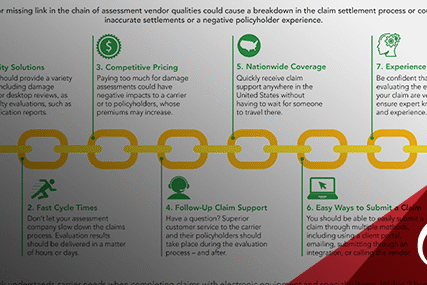
7 Critical Qualities of an Assessment Vendor
Adjusters need an assessment vendor that will strengthen the claim settlement process and not be the weak link.