Key Differences Between a Fire and Explosion Investigation

Explosions, as the National Fire Protection Association (NFPA) defines them, are “sudden, rapid releases of energy that produce potentially damaging pressures.” In industrial and manufacturing settings, these intense events can cause severe damage, put lives at risk, and result in intricate claims or legal challenges.
Although fire and explosion origin and cause investigations share many methodologies, there are some key differences. For legal and insurance professionals, understanding these differences is essential for accurately assessing claims and cases.
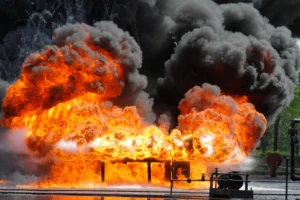
An origin and cause investigation can provide essential answers in the wake of a powerful explosion.
Comparing Fire and Explosion Investigation Methodology
At a foundational level, the methodologies used in fire and explosion investigations are virtually the same. Both leverage the scientific method, employing a step-by-step approach that involves forming hypotheses, systematically testing them, and validating conclusions. Additionally, each type of investigation hinges on systematic scene documentation and evidence preservation.
However, the scene itself, as well as the way it is documented, can differ significantly between fires and explosions. Explosion investigations often involve mapping extensive debris fields and analyzing blast effects, which may stretch far beyond the point of origin. The closest parallel for this process in a fire investigation would be fire dynamics and burn pattern analysis.
Other Differences in Explosion Investigations
There is also an important distinction to be made between the focus of a fire investigation, and that of an explosion. The purpose of a fire investigation is to identify the most plausible origin, cause, and development of a fire. In other words, the goal is to understand how the fire started, what fueled it, and how it spread.
But in an explosion investigation, experts are focused on uncovering the most plausible origin, cause, and mechanism of the explosion. This includes determining the type of explosion (chemical, mechanical, electrical, etc.), the materials involved, and the sequence of events that led to the rapid energy release. As a result, explosion investigations often involve analysis of blast patterns, pressure effects, fragmentation, explosive materials, and shock wave propagation. These investigations may require additional expertise in fields like chemistry, physics, and engineering to fully understand the dynamics at play.
Complicating Factors and Larger Scale
Explosion investigations may also present complexities that surpass those encountered in standard fire claims. These incidents typically involve an elevated risk of injury or loss of life and the potential for widespread damage. Fires may sometimes be confined to a single room or structure, while explosions can devastate entire buildings, neighboring structures, or even entire streets, amplifying the stakes for insurance and legal professionals managing claims or litigation.
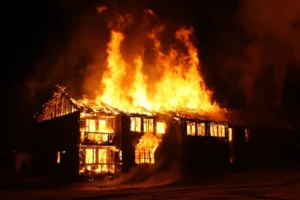
The damage from an explosion can spread well beyond its initial point of origin, engulfing multiple structures.
One major factor complicating explosion investigations is the increased number of parties involved. Multiple stakeholders—including property owners, manufacturers, governmental agencies, and utility companies—often have a vested interest in the outcome. Additionally, it is not uncommon for several investigators, each representing different insurance carriers, to work simultaneously on the scene. This requires careful management of the investigation to ensure collaboration without compromising the integrity or efficiency of the process.
Potential Explosion Scenarios
The complexity of an explosion varies significantly based on its nature. For instance, gas leaks are a frequent cause of residential explosions. These leaks can go undetected until the accumulated gas meets an ignition source, such as a water heater, triggering an explosion. The aftermath of such incidents can be catastrophic, causing severe damage to the home and posing a serious threat to neighboring properties.
Industrial explosions, however, often present even greater risks of injury and economic loss. These events commonly occur in facilities like chemical plants or manufacturing sites due to storage vessel failures. Overpressurization or mechanical damage may generate a sudden blast wave, releasing flammable vapors that can ignite upon encountering a spark or other ignition source. These types of explosions are particularly devastating, often causing widespread destruction and significant loss of life. With this larger scale, the pool of invested parties is likely to grow well beyond that of a residential explosion.
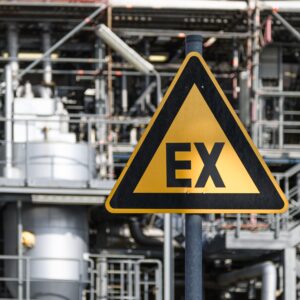
The presence of flammable materials and vapors can make industrial settings vulnerable to explosions.
Whether the site is residential or commercial, partnering with a reliable and experienced investigative team that can mobilize quickly is crucial for explosion origin and cause investigations. Choosing a team with a national presence can significantly reduce response times, while their expertise in hosting or collaborating on joint investigations adds invaluable support throughout the process.
National Fire Experts (NFE), part of Alpine Intel’s suite of services, is equipped to provide actionable intelligence after explosions, as well as in residential, commercial, industrial, vehicle, marine vessel, and specialty equipment fires. Each expert is a Certified Fire Investigator (CFI) and/or a Certified Fire and Explosion Investigator (CFEI) and is licensed in one or more states. These professionals are also certified by Alpine Intel, meaning every NFE investigator must undergo extensive training in customer service, report writing, and litigation support. For intelligence you can rely on for fires and explosions alike, submit an assignment.

Don’t miss insurance-focused resources and webinars about property, perils, and trends impacting claims nationwide by signing up for The Savvy Adjuster Newsletter.

Be sure to also tune in to The Savvy Adjuster Podcast to hear more from the experts themselves.
Alpine Intel’s content is meant to inform and educate readers using general terms and descriptions. They do not replace expert evaluations that determine facts and details related to each unique claim.
Related Resources

Your Questions About Fire Investigation Evidence Answered!
A crash course in how evidence is defined, collected, preserved by professional fire investigators, and how adhering to these guidelines ensures a conclusive investigation.

Fire Claims: From Investigation to Litigation
Your fire claims may require onsite investigations, transporting evidence, product assessments, and litigation support. Consider this all-inclusive path.

Case Study: Fireplace Fire Joint Investigation
Find out how National Fire Experts’ investigator identified the most plausible cause of a fireplace fire that caused damage to a home, even without fire scene access.