
3 Questions Product Failure Analysis Should Answer

Key Takeaways
Product failure analysis can help answer key questions when you’re evaluating subrogation potential, including:
- Was the failure caused by a manufacturing defect?
- Did an installation error lead to the failure?
- How did the product or component failure contribute to a fire?
Insurance and legal professionals are likely to encounter losses involving failed products or components that lead to additional property damage. This may take the form of a leaking washing machine valve that causes water damage or an appliance linked to the start of a structure fire.
Whatever the circumstances, understanding how and why a product failed can provide important context for evaluating recovery opportunities. Here are three questions product failure analysis should answer.
1. Did a Manufacturer’s Defect Cause This Product or Component Failure?
Manufacturers have a responsibility to produce and sell quality products, particularly if they could pose a risk to users and property should they fail. However, design or manufacturing mistakes may be made, and defective products or components may slip through quality control. That’s why it’s important to consider whether a manufacturer’s defect could be the cause of failure.
For instance, when a toilet supply line failed and leaked water into a bathroom, the adjuster handling the water damage claim needed to know why. A licensed Professional Engineer at Donan’s Component Testing Laboratories (CTL) performed a non-destructive study on the supply line and noted that the coupling nut was fractured all the way around, splitting it into two pieces.
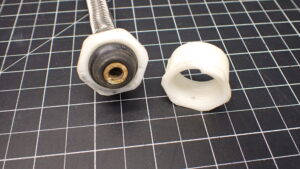
This coupling nut fractured and split into two pieces, and a thorough examination revealed evidence of a manufacturer’s defect.
The coupling nut in this claim was made of injection-molded plastic, and markings indicated that the way the plastic had been injected into the mold had left it vulnerable to stress and prone to fracture. The engineer’s objective product failure analysis determined that the component failed because of a manufacturer’s defect associated with improper design or injection-molding practices.
A product’s material composition can also contribute to a manufacturing-related failure. Most manufactured metal components are made from alloys, which combine two or more metals to achieve specific properties. The proportion of each metal can affect characteristics such as strength, corrosion resistance, and conductivity, as well as susceptibility to certain types of failure.
For example, brass is an alloy primarily composed of copper and zinc, with proportions varying depending on the desired properties. Brass containing high concentrations of zinc is susceptible to corrosion by dezincification or stress corrosion cracking (SCC).
Brass components used in plumbing must meet applicable codes and standards intended to reduce their susceptibility to SCC. Product failure analysis can help determine whether a failed brass component met these standards or whether metal composition resulted in a failure. A reputable product failure testing expert should have the specialized equipment needed to determine the metal composition of an alloy.
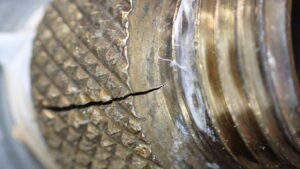
This brass coupling became brittle due to corrosion or dezincification and fractured under the stress. A CTL Professional Engineer determined that the manufacturer did not meet the required standards for this component.
2. Is an Installation Error the Reason for the Component or Product Failure?
Even when a product is properly designed and manufactured, errors during installation can place stress on components and contribute to premature failure. Product failure analysis can help identify physical evidence of improper installation and distinguish it from other potential causes.
For example, shortly after a new dishwasher was installed, a supply line fitting fractured and caused a significant water leak. During an on-site, non-destructive assessment, a CTL Professional Engineer observed evidence consistent with the fitting having been overtightened. The dishwasher’s recent installation, along with the condition and age of the components, indicated that the fitting was likely installed at the same time as the dishwasher.
Based on the available evidence, the engineer determined that the failure was consistent with improper installation. To further validate this finding, the dishwasher could be securely transported by CTL’s in-house evidence transportation service, Loss Logistics, for destructive product failure testing using a scanning electron microscope (SEM).
3. What Caused This Component or Product to Fail and Contribute to a Fire?
Not every product failure assessment involves a fire. However, when a fire investigation identifies a gas or electrically powered item as potentially contributing to the loss, additional testing may help determine why the item failed and what role that failure played in the fire.
Home appliances and other products can pose a fire risk because of misuse, improper installation, a manufacturer’s defect, or other factors. Burn patterns, evidence of arcing, melted plastic components, and other factors can help experienced Professional Engineers form an objective opinion about what caused a product failure and the resulting fire.
Consider a dryer that was determined to be linked to a fire. The adjuster handling the claim wanted to know how the dryer ignited the fire. An engineer at CTL evaluated the dryer and researched its model and date of manufacture. Research showed that the manufacturer had agreed to settle a class action lawsuit related to the sale of this type of dryer because it was known to cause fires due to lint buildup.
Burn patterns indicated that the fire was ignited by lint contacting the heating element and then circulating through the drum and into the lint filter. Once there, the lint ignited the filter and surrounding plastic components. The CTL engineer determined this was consistent with the failure described in the class action lawsuit.
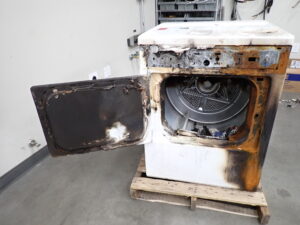
The burn patterns and other evidence helped a CTL Professional Engineer determine how the fire occurred and that the failure was consistent with the condition described in a class action lawsuit.
Insurance and legal professionals should turn to an objective expert for product failure analysis when they want answers about whether a manufacturer’s defect or installation error caused a loss or how a failure of an electrically powered product may have contributed to a fire.
Donan’s Component Testing Laboratories, part of Alpine Intel’s suite of services, operates two full-service facilities designed to evaluate product and component failures and answer these questions. If you need expert insight into the cause of a failure, submit an assignment to get started.
Engineering services are provided by or subcontracted to Donan Engineering, LLC, Donan Engineering NC, PLLC, or Donan Forensic, LP. National Fire Experts performs work in Indiana under Donan Engineering license PI20700047.

Don’t miss insurance-focused resources and webinars about property, perils, and trends impacting claims nationwide by signing up for The Savvy Adjuster Newsletter.

Be sure to also tune in to The Savvy Adjuster Podcast to hear more from the experts themselves.
Alpine Intel’s content is meant to inform and educate readers using general terms and descriptions. They do not replace expert evaluations that determine facts and details related to each unique claim.
Related Resources
Your Guide to Product Failure Testing Terminology
Use this glossary to better understand Donan’s CTL assessment process, the materials our engineers inspect, and the actionable conclusions they provide.
Lithium-Ion Battery Product Failure Testing Case Study
An adjuster sought conclusive evidence from CTL’s professional engineers and testing to determine a lithium-ion battery fire cause and subrogation potential.
Non-Destructive vs. Destructive Product Failure Testing Case Study
Read about how CTL’s Professional Engineers used non-destructive and destructive testing to help a subrogation firm pinpoint the cause of a plastic pipe leak.