Solenoid Valves & Subrogation Potential Explained in 5 Questions

This resource for insurance and subrogation professionals asks and answers five important questions about solenoid valves:
- What are they and where are they found?
- How do they work?
- How can they lead to water damage claims?
- What causes them to fail?
- How can you use expert opinions to evaluate related subrogation opportunities?
Solenoid valves may be small, but when they fail, the resulting water losses can be anything but. These valves play an important role in managing water flow through a range of appliances and plumbing systems present in most homes and many commercial properties.
The following five questions and their answers can help you understand solenoid valves and why taking a closer look at failures is important for assessing subrogation potential.
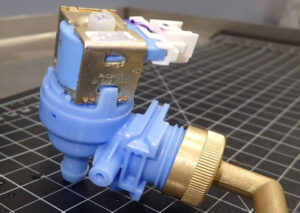
Failed solenoid valves like this one are a common cause of appliance-related water damage claims.
1. What Is a Solenoid Valve and Where Is It Found?
Solenoid valves are electrically controlled valves that regulate the flow of water into or through an appliance. They are commonly found in refrigerators, dishwashers, washing machines, steam dryers, and some water fountains. You may also see these components called electrically operated valves or solenoid-controlled water valves. Knowing this terminology can make it easier to recognize them in repair records or other documentation related to a water damage claim.
2. How Does a Solenoid Valve Work?
A solenoid valve uses an electrical signal to automatically start and stop the flow of water to an appliance. When the appliance needs water, the solenoid is energized, creating a magnetic field that opens the valve. When power to the solenoid is turned off, a spring returns the valve to its closed position and stops the flow of water.
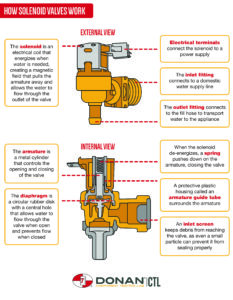
This labeled diagram highlights key components of solenoid valves and their functions. Get a copy of the full Understanding Solenoid Valves and Leaks Guide.
3. How Can a Solenoid Valve Failure Lead to a Water Damage Claim?
Because solenoid valves control water flowing into or through appliances, a leak can cause water damage to flooring, building materials, and nearby property, including HVAC equipment and electrically powered items. The extent of damage can depend on where the valve fails, how water escapes, which materials or components are exposed, and how long the exposure lasts.
Leaks from the inlet side or valve body may drip or spray water outside the appliance or plumbing component. If the valve leaks through the outlet fitting, water may continue flowing into the appliance even when the valve should be closed, causing it to overflow if the water supply isn’t shut off.
4. What Causes Solenoid Valve Failures?
Solenoid valves can fail and leak because of plastic degradation, stress concentrations, deficient materials, overpressurization, or cross-threaded inlet connections. Some of these failure modes could be due to a manufacturing defect or installation error and may indicate subrogation potential.
Plastic Degradation Causes a Fracture
Disinfectants commonly found in water supplies, including chlorine, chloramine, and chlorine dioxide, can degrade plastic and rubber components, leading to fractures and leaks. Manufacturers should anticipate exposure to common water disinfectants and select materials capable of withstanding those conditions.
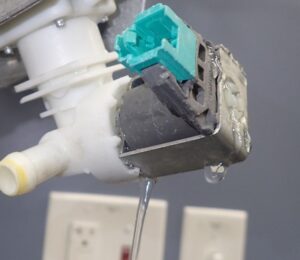
This solenoid valve leak is the result of plastic degradation and may signal a manufacturing defect.
Stress Concentration Cracks Plastic Components
Sharp corners in molded plastic components can concentrate stress, making plastic more susceptible to cracking. Expert product failure testing can help determine whether this type of failure is related to the solenoid valve’s design or manufacture.
Deficient Brass May Lead to Fitting Fractures
Brass fittings connected to solenoid valves can fracture and leak. If testing identifies deficient brass material as the cause, the failure may indicate a manufacturing defect.
Overpressurization Causes a Valve Failure
Overpressurization occurs when a solenoid valve is exposed to pressure beyond its design limits. This can fracture the valve body and typically produces bifurcating, or branching, fracture patterns. This type of failure is often caused by freezing.
Cross-Threaded Inlet Connections Result in a Leak
Cross-threading occurs when the mating threads of an inlet connection and fitting are misaligned, creating a poor seal that could leak immediately or over time. This failure may result from improper installation.
5. How Can You Evaluate Whether a Solenoid Valve Failure Presents Subrogation Potential?
Professional Engineers can conduct product failure testing to determine why a solenoid valve failed and whether factors such as a manufacturing defect or installation error contributed to the failure. Insurance and subrogation professionals can then use these insights to decide whether to pursue subrogation.
Donan’s Component Testing Laboratories (CTL) tests failed solenoid valves as individual components or as part of an appliance. Either can be taken to CTL’s East or West location by its in-house transportation and evidence preservation service, Loss Logistics. Once at one of these state-of-the-art facilities, Professional Engineers can use non-destructive or destructive testing, depending on the client’s needs and preferences, to determine the cause of failure.
Non-destructive solenoid valve testing may include:
- Visual inspections
- Pressure testing
- Functional testing
- Longevity testing
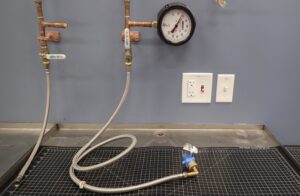
Pressure testing can help engineers evaluate a solenoid valve and determine the cause of failure.
Destructive testing may include examining a solenoid valve’s fracture surface with a scanning electron microscope (SEM) or using Fourier transform infrared spectroscopy (FTIR) to analyze the composition of plastic materials.
Whether your investigation calls for non-destructive or destructive testing, CTL has the technical knowledge to identify the cause of solenoid valve failures. CTL’s licensed engineers can also investigate failures involving a wide range of plumbing components, appliances, and electrical products, including those involved in fires.
Submit an assignment to get the expert, objective opinions you need to make informed subrogation decisions.
Engineering services are provided by or subcontracted to Donan Engineering, LLC, Donan Engineering NC, PLLC, or Donan Forensic, LP.

Don’t miss insurance-focused resources and webinars about property, perils, and trends impacting claims nationwide by signing up for The Savvy Adjuster Newsletter.

Be sure to also tune in to The Savvy Adjuster Podcast to hear more from the experts themselves.
Alpine Intel’s content is meant to inform and educate readers using general terms and descriptions. They do not replace expert evaluations that determine facts and details related to each unique claim.
Related Resources

Understanding Solenoid Valves and Leaks Guide
Solenoid valves are vital components that regulate water use in common household appliances like refrigerators, dishwashers, and washing machines.

Exploring Subrogation Potential: Plumbing and Appliance Failures
Use this interactive guide to learn about appliance and plumbing failures identified at Component Testing Laboratories that may warrant subrogation.

Unlocking Subrogation Potential in Property Losses eBook
Download this eBook to get actionable strategies for optimizing your subrogation efforts through expert product failure testing.