
6 Types of Fire Patterns and Their Role in O&C Investigations

Key Takeaways
This article explains:
- Fire effects, fire patterns, and how they factor into origin and cause investigations
- Six important fire pattern types certified fire investigators often evaluate at fire scenes
- Why relying on certified fire investigators who avoid expectation and confirmation bias is essential for accurate claim resolutions
To the untrained eye, a fire scene may seem like a chaotic mix of debris and charring that’s beyond interpretation. For certified fire investigators, however, these same sites present a wealth of valuable data, including fire effects and fire patterns.
By systematically gathering and analyzing this information, investigators can develop, test, and select a final hypothesis regarding a fire’s most plausible origin and cause. These findings play a key role in helping insurance professionals ensure accurate and fair claim resolutions.
Read about fire effects and six types of fire patterns to better understand how they contribute to origin and cause determinations.
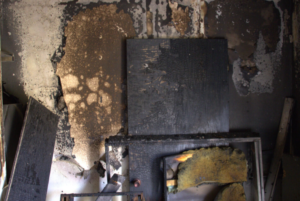
Certified fire investigators document the effects and patterns left by fires during the initial stages of an origin and cause investigation.
What Are Fire Effects and Fire Patterns?
National Fire Protection Association (NFPA) 921, which establishes standards for scientifically based fire and explosion investigations, defines fire effects as “the observable or measurable changes in or on a material as a result of a fire.” As fire investigators conduct their on-site studies, they typically observe and record fire effects such as:
- Deformation of items or materials
- Deposition of soot and smoke
- Discoloration of surfaces
- Mass loss from materials
Fire effects and their associated characteristics combine to create fire patterns, which are visible or measurable physical changes or identifiable shapes, formed by one or more fire effects, according to NFPA 921. Investigators interpret fire patterns and analyze how they may have been formed to help determine how a fire spread.
What Are Common Types of Fire Patterns?
Chapter 6 of NFPA 921 describes types of fire patterns, including plume-generated, ventilation-generated, hot gas layer-generated, full room involvement-generated, fire suppression-generated, and undetermined-generated patterns. To ensure they can make confident fire claim decisions, insurance professionals should only work with investigative partners who have the expertise to identify, understand, and accurately interpret these patterns.
- Plume-Generated Patterns
Fire plumes are formed by combustion products rising above burning fuel packages. They are 3D and create distinct 2D patterns when they intersect with walls, ceilings, or other vertical surfaces. These may be described by their shape and include:
- V-shaped patterns
- Inverted cone patterns
- Hourglass patterns
- U-shaped patterns
- Pointer and arrow patterns
- Circular-shaped patterns
Fire patterns evolve as a fire grows, meaning that fire investigators must recognize that the patterns that remain after a fire has been extinguished may have transitioned through several different shapes beforehand. In other words, the absence of a certain pattern on this list at a fire scene doesn’t mean it didn’t exist earlier in the fire’s progression.
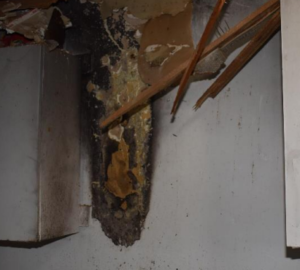
This image shows an example of a V-shaped, plume-generated fire pattern.
- Ventilation-Generated Patterns
How a room is ventilated—via windows, HVAC systems, or open doors—can affect both a fire and the patterns it creates.
Areas near ventilation openings often show extensive damage due to the influx of fresh oxygen fueling the fire. This means that heavy damage does not always signal the fire’s point of origin. Instead, it may highlight where the fire had the greatest access to air.
- Hot Gas Layer-Generated Patterns
During a fire, layers of hot gas can also create patterns. These often manifest as radiant heat damage to upper surfaces and floor coverings and sometimes affect floors in nearby areas such as hallways or porches.
A clear line of demarcation may appear on walls, marking the lower edge of the hot gas layer. Damage is usually consistent, except where there is drop down (falling debris that burns upward), easily ignitable items, or protected areas.
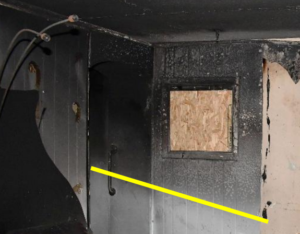
The yellow line here highlights a line of demarcation that was created by a hot upper gas layer.
- Full Room Involvement-Generated Patterns
When a fire fully engulfs a room, it often causes widespread damage at lower levels. This may involve charring beneath furniture, burning of carpets and baseboards, and even holes in the floor.
While the scope of damage worsens over time, full room involvement can cause severe lower-level damage within a relatively short period—often minutes—depending on factors like ventilation and available fuel.
- Suppression-Generated Patterns
Fire suppression efforts are another critical factor for investigators to consider. The use of water, suppression agents, or ventilation by firefighters can create or modify fire patterns.
To accurately interpret these patterns, investigators must communicate with the fire suppression team to understand what actions were taken—or not taken—during the firefighting process.
- Undetermined-Generated Patterns
In some cases, the origin of a fire pattern cannot be identified. This may occur when the fire damage is too severe or when multiple factors make it difficult to attribute the pattern to a single generation mechanic (such as plume, ventilation, or hot gas layer effect).
Avoiding Expectation Bias, Confirmation Bias, and Unfounded Conclusions
In addition to describing these pattern types in detail, NFPA 921 makes it clear that investigators should focus solely on recording observations during the first stage of a fire investigation. All data should be collected before any of it is analyzed or interpreted. Only after all relevant data has been collected should the investigator develop and systematically test hypotheses about origin and cause, discarding those that are not supported by the evidence in accordance with NFPA 921’s scientific method. This helps prevent expectation bias, which NFPA 921 defines as “a phenomenon that occurs when investigators reach a particular conclusion based on expectations without having examined or collected all the relevant data.”
Investigators must also be vigilant against confirmation bias, which occurs when they focus only on data that aligns with their hypothesis while neglecting, disregarding, or dismissing evidence that contradicts it. Both forms of bias can compromise the integrity of an investigation, skew conclusions, and ultimately lead to inaccurate claims resolutions.
The certified fire investigators at National Fire Experts (NFE), part of Alpine Intel’s suite of services, are unbiased and adhere to NFPA 921. They use a systematic, 11-step process to determine the origin and cause of any fire scene, as well as recommended next steps. Insurance professionals can have peace of mind knowing that NFE conclusions are sound and actionable. Submit an assignment today.

Don’t miss insurance-focused resources and webinars about property, perils, and trends impacting claims nationwide by signing up for The Savvy Adjuster Newsletter.

Be sure to also tune in to The Savvy Adjuster Podcast to hear more from the experts themselves.
Alpine Intel’s content is meant to inform and educate readers using general terms and descriptions. They do not replace expert evaluations that determine facts and details related to each unique claim.
Related Resources

Apartment Fires: Causes and Investigations Guide
Learn common causes of apartment fires, how investigators approach assessments, and the characteristics that can introduce unique considerations to these claims.
Navigating Marine Vessel Fire Investigations Guide
Learn about what makes marine vessel fire investigations particularly complex and become better prepared to handle related claims or cases.

Types of Canvassing To Bolster Claim Investigations
Canvassing can help insurance professionals verify facts of a claim without sacrificing objectivity, accuracy, or fairness.