How To Reduce Claims Leakage From HVAC & Refrigeration Claims
Key Takeaways
This article for adjusters offers:
- Insights on the costs and impacts of HVAC-related claims leakage
- Best practices for reducing it
- 2025 HVAC claims data to inform improved processes
When water leaks from the ceiling, many people stick a bucket underneath. Each droplet may be barely visible, but if the leak isn’t repaired, the bucket will eventually overflow. Claims leakage can be a lot like this.
As an adjuster, you may have unintentionally overpaid claims with HVAC or refrigeration equipment by $1,000. That claims leakage doesn’t seem like much, but $1,000 over every claim from every adjuster could eventually have larger consequences for the carrier.
Let’s return to the water example. What if the leak is hidden in the attic? Without detection or repair, the water could ultimately cause catastrophic damage. Similarly, carriers may not realize the extent of claims leakage caused by flawed processes until an audit uncovers it—and by then, it could have affected both the carrier and its policyholders. Premiums may have increased to make up for the losses, and policyholder satisfaction may have decreased.
Mitigating claims leakage from HVAC and refrigeration claims is possible with a few simple changes.
Even a slow, steady drip of claims leakage can add up over time, turning a minor issue into a much larger and more costly problem for carriers.
How Much Does Indemnity Leakage From HVAC and Refrigeration Claims Really Cost?
In 2025, the objective experts at HVACi assessed hundreds of thousands of HVAC and refrigeration systems and compiled data from these assessments in the HVACi 2025 Annual Claims Report.
One of the report’s key findings revealed a significant gap between average claimed amounts and average recommended settlements. For residential HVAC and refrigeration claims, the difference was nearly $8,000. For commercial claims, that gap exceeded $41,000.
The disparity was even greater in multi-system large losses affecting properties such as schools, apartment complexes, and shopping centers. In these claims, the difference between the average claimed amount and HVACi’s recommended settlement surpassed $665,000, representing an increase of nearly $59,000 compared to 2024.
Like water steadily filling a bucket, these costs accumulate quickly.
Best Practices for Minimizing Claims Leakage From HVAC and Refrigeration Losses
Adjusters can focus on implementing the following strategies to help their carriers reduce claims leakage in losses that include HVAC or refrigeration equipment.
Verify the Cause of Loss for Every Claim
HVAC claims are not always filed with the correct cause of loss. Of the perils that were originally reported by policyholders in 2025, 48% were recategorized following HVACi’s comprehensive, objective assessment. Additionally, 38% of equipment evaluated was determined to have a cause of loss not typically covered by insurance policies.
These statistics highlight just how easily peril misclassification can lead to unnecessary settlements. By confirming the actual cause of loss, adjusters can verify that they are only settling for equipment that was damaged by a covered peril.
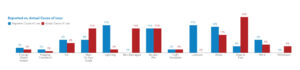
This graph from the HVACi 2025 Annual Claims Report compares the causes of loss reported by policyholders with the actual causes identified by HVACi in residential HVAC claims.
Determine the Scope of Damage
Not all equipment included in a claim may be damaged to the same extent, and some items could be functioning properly. One-fifth of all equipment HVACi assessed across residential and commercial claims was operating as designed. This is particularly common in multi-system large loss HVAC claims, where every system on-site is often included, regardless of if it was affected. In fact, HVACi determined that 45% of equipment in these claims was functioning properly at the time of assessment.
An on-site inspection by a third-party expert can help adjusters determine whether equipment is actually damaged and, if so, assess the extent of that damage.
Evaluate if Repairs Are a Better Solution Than Replacements
The best solution to return HVAC equipment to pre-loss condition is often not a full replacement. Half of all systems HVACi assessed in 2025 could be repaired. For certain types of claims, this number was even higher; 78% of residential HVAC equipment with confirmed hail damage could be restored to pre-loss condition through a minor to major repair.
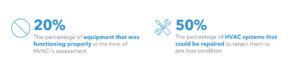
These key findings from HVACi’s 2025 claims data show that not all claimed equipment is actually damaged, and many losses do not require full system replacement.
Research Market Value Pricing
Adjusters may have confirmed the loss is a covered peril and could still settle for more than is necessary if they don’t review market value pricing for Like Kind and Quality systems. Equipment and labor pricing fluctuates based on brand, features, and the policyholder’s location. Not considering these could cause an adjuster to overpay or even underpay for HVAC claims.
Seek Expert Support
Underlying causes of claims leakage could be human error, insufficient training, and guesswork—often through no fault of the adjuster. Adjusters don’t have to be experts on every claimed item that crosses their desks. However, getting expert support can decrease claims leakage potential. Subject matter experts can provide a definitive cause of loss and scope of damage to ensure more accurate claim settlements.
HVACi, part of Alpine Intel’s suite of services, is an all-in-one claims solution. We apply our knowledge and experience to thoroughly evaluate claimed HVAC and refrigeration equipment throughout the United States. Our professionals complete testing based on engineering best practices to verify cause of loss and determine scope of damage. Then we deliver objective, comprehensive reports that include repair and replacement recommendations, settlement recommendations, and market value pricing for necessary equipment. Adjusters have all the tools they need to settle the claim with minimal overage.
Add fewer drops to the claims leakage bucket. Submit an assignment to HVACi to settle HVAC and refrigeration claims more confidently and accurately.

Don’t miss insurance-focused resources and webinars about property, perils, and trends impacting claims nationwide by signing up for The Savvy Adjuster Newsletter.

Be sure to also tune in to The Savvy Adjuster Podcast to hear more from the experts themselves.
Alpine Intel’s content is meant to inform and educate readers using general terms and descriptions. They do not replace expert evaluations that determine facts and details related to each unique claim.
Related Resources
Complex Commercial HVAC Claims Case Study
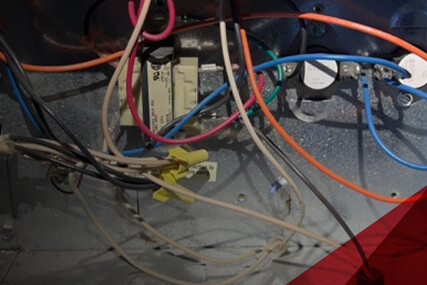
Commercial HVAC claims may be more complex for adjusters to resolve than residential claims, since they often include multiple different types of systems with varied damages, or even multiple causes of loss.
Unexpected Twists in HVAC Claims
An accurate cause of loss can ensure a fair outcome that prevents claim leakage and reoccurring damages. This guide examines several claims that had surprising causes of loss following an assessment.