
When Lightning-Damaged Trees Cause Property Claims

In this article, you’ll learn:
- How lightning-damaged trees can lead to property claims
- Characteristics that make trees more vulnerable to lightning strikes
- What a lightning-damaged tree might look like
From stripping the bark to causing trunks to rupture, lightning can severely damage trees and lead to property claims.
Nearly half of all trees struck by lightning die instantly, according to the U.S. Department of Agriculture.
Insurance professionals should know what makes trees susceptible to lightning and how lightning-damaged trees can fall. This leaves them better equipped when severe storms and catastrophe events hit their coverage areas, cause structural or vehicle damage, and require tree or tree debris removal.
What Makes Trees Susceptible to Lightning Strikes?
Age, location, species, and conductivity levels can influence a tree’s likelihood of being struck by lightning and the extent of resulting damage.
Age and Height
Older, or more mature, trees tend to be taller and have larger canopies. This added height makes them more vulnerable to lightning simply due to higher exposure than younger, shorter trees.
Location
Trees at higher elevations or in more isolated areas are also more exposed to the elements. In a residential setting, for example, a single tree in a backyard has more risk of being struck than a cluster of trees in a wooded area. Tall trees near bodies of water also have a greater likelihood of attracting lightning, according to the Clemson Cooperative Extension.

More mature trees, especially those in isolated areas or standing alone in a backyard, have a higher chance of being struck by lightning.
Species
The genetic makeup of certain tree species makes them more prone to lightning strikes than others. Among those more vulnerable are oaks, elms, ash, spruce, tulip poplar, and pines, according to the Bernheim Forest and Arboretum. Beech, birch, maple, and holly species are less susceptible.
Conductivity Levels
Trees have high conductivity levels, meaning they’re more likely to hold an electrical current long enough for at least minimal damage to occur. A 2020 study on long-term conductivity measurements, published in the journal “Geology, Earth & Marine Sciences,” found that air temperatures, seasons, and water resources affect a tree’s conductivity levels.
When the perfect storm of lightning-related vulnerabilities strikes a tree, damage isn’t always immediate or noticeable. But the effects, regardless of how soon they appear, can lead to property claims that require tree or tree debris removal.
What Happens When Lightning Strikes a Tree?
Trees that have died from, or been otherwise weakened by, lightning strikes have the potential to cause immediate and delayed property damage.
The Clemson Cooperative Extension states that lightning follows “the most conductive path between the top and the roots” of a tree, which results in external and internal wounds.
Visible effects include bark damage, deep vertical cracks, or severely split branches or trunks. If more than one-third of a tree’s circumference has sustained bark damage, this could lead to future fungal or insect infestations, according to the University of Nebraska-Lincoln Institute of Agriculture and Natural Resources.
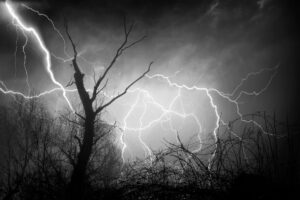
Lightning can inflict both immediate and long-term damage on trees that can precede property claims.
In rare cases, lightning may strike a tree and arc to a nearby structure, initiating a fire. This occurred in 2023 to a Connecticut home when a backyard tree was struck and the electricity traveled through a gas line into the residence.
In many instances, trees can recover without requiring removal or take on the damage but appear unscathed. However, even if there are no visible or immediately noticeable signs on lightning-damaged trees, the electrical currents that pulsed through the tree can still lead to root decay and other ailments that may later cause the tree to fall on property.
Greenery that was already dead but still standing, had weak structural integrity, or was otherwise unhealthy could immediately break following a lightning strike, impacting roofs, smashing windows, or falling on a vehicle—all of which might require tree and debris removal before the damage can be assessed for a claim.
The Aftermath of a Lightning Strike
Whether a tree falls during the same storm in which it was struck by lightning, or later due to prolonged damage or deteriorating health, the threat of property, vehicle, or structural damage remains the same. And tree or tree debris removal likely will be required.
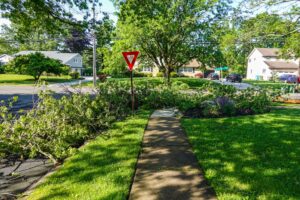
When lightning strikes a tree, branches may fall and require emergency removal services from a certified tree care vendor.
Roofs, vehicles, fencing, and other elements on a property can sustain impact damage. Lightning-damaged trees may also obstruct roadways or make a home unsafe to occupy. When these scenarios arise, having a certified and reputable tree care vendor is vital.
HMI responds swiftly to remove trees and tree debris safely so as not to delay claim resolutions. The certified tree care professionals in HMI’s network can expertly inspect outdoor property features or identify concerns to provide comprehensive recommendations. HMI, part of Alpine Intel’s suite of services, specializes in emergency tree removal, invoice reviews, outdoor property consulting, and risk mitigation solutions for the insurance and risk management industry. Submit an assignment today.

Don’t miss insurance-focused resources and webinars about property, perils, and trends impacting claims nationwide by signing up for The Savvy Adjuster Newsletter.

Be sure to also tune in to The Savvy Adjuster Podcast to hear more from the experts themselves.
Alpine Intel’s content is meant to inform and educate readers using general terms and descriptions. They do not replace expert evaluations that determine facts and details related to each unique claim.
Related Resources
Lightning and Surge Impacts in Property Claims Guide
Lightning and surge are the most frequently reported or determined cause of loss for commercial and residential policyholders.
Adjuster’s Guide to Lightning Claims
Explore this interactive guide to learn about different types of lightning and what a Lightning Verification Report can tell you about what happened at a loss location during a storm.
The 5 W’s of Lightning Claims for Adjusters Guide
Adjusters must solve the 5 W’s – Who, What, When, Where, and Why – before settling any property claim, and lightning claims are no exception.