
Onsite Engineering Assessments Tools of the Trade

A fair and informed settlement decision about a structural property claim requires knowing the actual cause and scope of loss. Forensic engineers rely upon their expertise and experience in the field, but delivering defensible conclusions depends on more than observation. Having the right tools—and the knowledge of how to use them—enhances onsite assessments and ensures more accurate results. From specialized instruments to safety gear, these tools help experts like Donan’s forensic engineers form scientifically backed conclusions. Presented to the client via peer-reviewed professional reports, these conclusions support strong claim decisions.
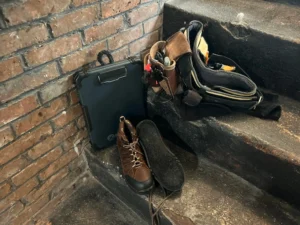
Accurate forensic engineering assessments require the right tools for the job, as well as the expertise needed to interpret measurements, readings, and other data.
Donan’s Onsite Forensic Engineering Assessment Process
The assessment process begins once Donan Engineering receives the necessary claim details. An engineer is promptly assigned and the policyholder or their representative is contacted to schedule a site visit. When onsite, the engineer applies the scientific method to collect evidence, and later compares the property and their findings to relevant research, codes, or standards. Their initial findings are usually conveyed through a verbal report, followed later by a peer-reviewed written report. The tools selected for each investigation depend on both the nature of the peril and the specific characteristics of the property.
Tools of the Trade
While the tools employed by a forensic engineer on each unique loss site may vary, here are some common instruments used to take measurements, review evidence, and reach an accurate cause of loss.
- Tape Measure or Ruler: Tape measures are a common item in an engineer’s toolkit, used for basic measurements, including to help determine lengths of damaged components and high-water marks. Rulers can demonstrate the size of gaps, cracks, or dents. They may appear in report images to demonstrate and preserve evidence of conditions at the time of the assessment.
- Camera: Engineers may use digital cameras to document visible conditions and testing results at the time of assessment. These images, some of which are included in stamped engineer’s reports, provide a record that can be helpful during potential disputes.
- Moisture Meter: This digital device measures the moisture content or relative moisture reading of wood, drywall, concrete, and more, which is helpful in determining whether a property has active areas of elevated moisture. Some are pin-types, which penetrate the material and detect electrical resistance, and others are pinless and read electromagnetic waves.
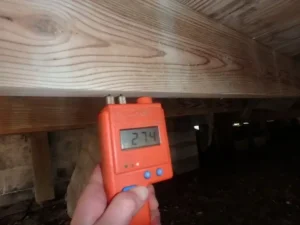
Moisture meters, like this pin-type one used on a floor framing member, measure a material’s moisture content, which can help an engineer determine if there is water-related damage.
- Chalk: Engineers use chalk to mark blemishes to establish damage patterns, particularly when hail is a suspected cause of loss. In soft metal components, chalk marks can also expose impact dents from hail and other projectiles.
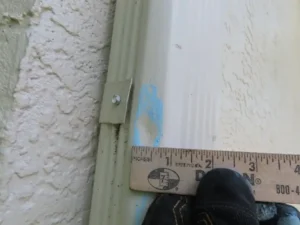
Dents in shingles and collateral indicators may not be immediately evident, but chalk can make them clearer in photographs and easier for the engineer to measure.
Levels: Levels measure horizontal and vertical surfaces to ensure they are level or plumb, respectively, within an acceptable degree according to building codes. Many levels are handheld and are used to measure slope, but some engineers may use an altimeter, such as a ZipLevel, or other high-precision tools to certain assessments. These instruments use a pressurized system with a liquid-filled cord to measure elevation, which can be helpful in obtaining measurements such as ground slope away from a structure or floor elevation changes within a building.
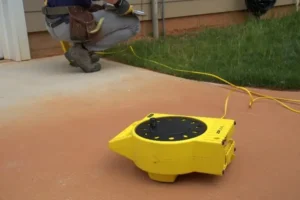
This ZipLevel is one tool engineers may use to determine if the ground surrounding a building slopes away from the foundation adequately for proper drainage.
Pitch Gauge: A pitch gauge may be a flat card that, when held up against the silhouette of a roof, allows the engineer to determine the slope. Other pitch gauges are instruments that can be placed directly on the roof to provide a reading. These tools are helpful in determining whether roofing materials are appropriate for the pitch and that water can drain away, as well as verifying that a roof is not too steep to safely access.
Drone: When roofs are too steep or areas of the property are not safe or otherwise accessible, drone footage may allow an engineer to document the property’s condition at the time of the assessment.
Roof Boots: Depending on the material and condition, accessing some roofs requires footwear with improved grip, straps, and other features that help ensure the engineer’s safety without impacting the roofing materials.
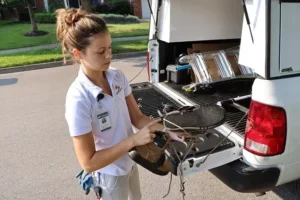
The enhanced grip on specialized roofing shoes allows engineers to walk safely on a roof without damaging shingles and other materials.
Roof Ladder: To access the roof and assess areas near gutters and eaves, engineers may use a ladder specifically designed for the task. These ladders have non-slip rungs and may include hooks that allow them to attach to the roof edges in a way that minimizes damage.
Climbing Assists: For steep roofs, additional climbing tools may be needed. Certain climbing assists have a hook-and-wheel-system that allows for easier, safer movement. Engineers may also use ropes and harnesses on particularly steep roofs.
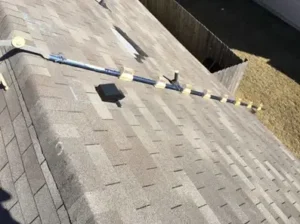
Climbing assists for steep roofs provide additional grips to keep engineers safe while still allowing for thorough assessments.
Databases: Not all tools an engineer uses are physical. When reviewing their findings, they also draw upon accurate databases, including those for weather data, recalls, manufacturing defects, class action lawsuits, materials, and codes. While onsite evidence is the most important factor in accurate determinations, research is essential for ensuring a structure is code compliant and to support or eliminate a weather-related cause of loss.
Why Assessments Matter
No two claims are exactly the same, and as such, there’s no one-size-fits-all approach to onsite forensic engineering assessments. The combination of tools used is determined by the type of peril involved—whether it’s hail, wind, structural failure, or water intrusion—and the property’s condition. However, what remains consistent is the commitment to precision, safety, and scientific rigor. Each tool, whether a simple chalk line or a precise moisture meter reading, plays a crucial role in helping engineers document, evaluate, and report their findings with clarity and credibility.
For claims professionals, understanding this toolkit helps interpret the conclusions laid out in forensic engineering reports. It also highlights the expertise and diligence behind each conclusion, something especially valuable when findings are used in negotiations or litigation. At Donan Engineering, part of Alpine Intel’s suite of services, our team is equipped with not just the right tools but also the training and experience to use them effectively, helping our clients make informed, confident decisions backed by science. Submit an assignment to experience the difference firsthand.

Don’t miss insurance-focused resources and webinars about property, perils, and trends impacting claims nationwide by signing up for The Savvy Adjuster Newsletter.

Be sure to also tune in to The Savvy Adjuster Podcast to hear more from the experts themselves.
Alpine Intel’s content is meant to inform and educate readers using general terms and descriptions. They do not replace expert evaluations that determine facts and details related to each unique claim.
Related Resources
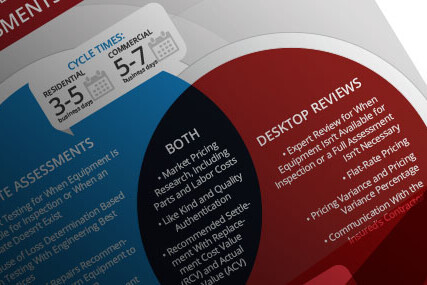
Onsite Assessments and Desktop Reviews Guide
Compare the uses and benefits of obtaining either an onsite assessment or a desktop review with our one-page guide.
StrikeCheck Electrical System Assessment Tools of the Trade
Learn what tools StrikeCheck’s experts use for electronics inspections and how their conclusive insights aid with accurate claim resolutions.

Playtime Is Over: Toys in StrikeCheck Assessments
This slideshow demonstrates why you shouldn’t settle claims involving toys and other leisure items without a full assessment.