Less Common Commercial HVAC Systems Adjusters Should Be Familiar With

Key Takeaways
Read this piece to learn more about:
- Lesser-known commercial HVAC systems and how they work, including exhaust fans, chillers, and make-up air units
- Upblast vs. downblast exhaust fans and air-cooled vs. water-cooled chillers
- Perils that can impact each of these equipment types
- How working with an expert assessment partner can make accurately resolving claims with these commercial HVAC systems easier
Most commercial policyholders use package units and split systems; however, other types of commercial HVAC systems are prevalent in claims. Among them are exhaust fans, chillers, and make-up air units. It’s important adjusters know a little about each kind of HVAC system—even less common ones—to ensure the most accurate settlement decisions.
Exhaust Fans
In 2025, exhaust fans were the fifth most-claimed type of equipment in commercial HVAC claims assessed by HVACi. They are found in commercial kitchens, offices, manufacturing, and warehouse buildings and are used to remove stale air, cooking odors, and excessive moisture or heat. They can be advantageous for policyholders because they:
- Ventilate a space to provide fresh air
- Improve air quality for a healthier atmosphere indoors
- Remove moisture to prevent mold growth
Exhaust fans are a type of commercial HVAC system that operates by a motor turning either fan blades or a blower wheel, depending on the kind, to pull contaminated air out of the building. Belt driven units rely on a belt to connect the fan or blower to the motor. In a direct drive unit, the motor is connected to the fan blades or blower wheel by a shaft or axle, and the blades rotate with the motor.
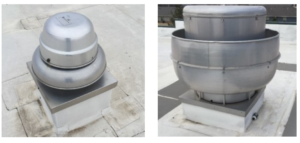
Downblast exhaust fans, left, are best for applications unrelated to cooking; whereas, upblast exhaust fans trap grease remnants left in the air, so they don’t cause damage to equipment or the roof.
Upblast vs. Downblast Exhaust Fans
Policyholders may use an upblast or downblast exhaust fan, depending on their needs. Upblast exhaust fans are ideal for spaces with commercial kitchens, including restaurants or hotels. Air is blown out of the top, and, more importantly, a sealed compartment protects the motor from the heat, moisture, and contaminants being removed. Additionally, a secondary grease trap captures condensed grease to prevent it from getting onto the roof.
In contrast, downblast exhaust fans should never be used for kitchens or in places where contaminated air has grease. Downblast fans eject the air down toward the fan base and roof, which protects the motor from precipitation but could be a fire hazard if grease accumulates there. Downblast exhaust fans should be used to remove heat, stale air, and odors.
Among the predominant causes of loss for exhaust fans are hail and wind; however, a third of the exhaust fan systems were in proper working condition at the time of HVACi’s assessment.
Chillers
Chillers are a key type of commercial HVAC system commonly used in airports, hospitals, hotels, shopping malls, restaurants, temporary structures, and industrial or medical facilities. They transfer heat out of a space using water or a water solution instead of air. Policyholders may have water-cooled or air-cooled chillers; however, the initial process is the same.
Warm water enters the evaporator unit from the primary return coming from the building’s Air Handler Units (AHUs) and its heat is transferred to the refrigerant. The now cooler water is then pumped by a water pump through the primary supply back to the AHU. A blower and the ductwork bring in air from the facility, and the water absorbs its heat. The now cooler air is supplied back to the conditioned space through the ductwork. This process is similar to that of a traditional HVAC split system or package unit. The warmer water then returns to the evaporator to restart the process.
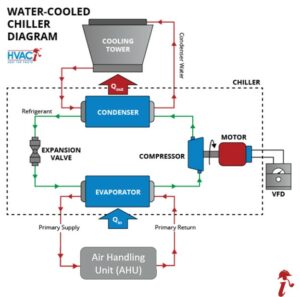 The processes for how water-cooled and air-cooled chillers work are almost identical except for the method used to transfer heat from the refrigerant.
Air-Cooled vs. Water-Cooled Chillers
The difference between air-cooled and water-cooled chillers is how the refrigerant transfers out the heat it absorbed from the water. Refrigerant moves from the evaporator to the compressor, which increases the refrigerant’s pressure and temperature, and then it goes to the condenser. In water-cooled chillers, water surrounds the refrigerant pipes to absorb the heat and then is pumped into a cooling tower to release the heat. Meanwhile refrigerant goes through the expansion valve to reduce its pressure and temperature and restart the process. In air-cooled chillers, fans bring outside air through the condenser, which absorbs heat from the refrigerant, and expels it to the ambient air–much the same as the process for traditional split systems and package units.
Despite the complex processes, chillers may be preferred over traditional split systems and package units because water conducts heat 25 times better than air. Each chiller type also has advantages. Water-cooled chillers are:
- Better at conducting heat
- More consistent
- Best for medium to large facilities
However, they require a stable water supply and a lot more maintenance.
Air-cooled chillers are preferred by some policyholders because they are:
- Better for small to medium facilities
- Have lower installation costs
- Require less maintenance
- Take up less space
Among the perils affecting chillers are corrosion and poor maintenance, which are linked with wear and tear, as well as electrical problems caused by wear and tear or high voltage surges.
Make-Up Air Units
Make-up air units are another significant type of commercial HVAC system. While they aren’t claimed as often, make-up air units are frequently determined to be functioning as designed, making damage assessment essential.
As the name implies, make-up air units compensate for air that was removed by exhaust fans or other mechanical means. While exhaust fans draw air out of a facility to the outside, make-up air units reclaim fresh air from outside to bring it into the building. However, unlike ventilation fans that bring in outside air without changing its temperature, make-up air units can temper air so the heating or cooling system won’t have to work harder or waste energy.
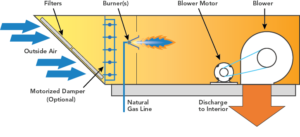 Make-up air units provide tempered fresh air into spaces that have a lot of mechanical ventilation taking air out.
Make-up air units are typically used in industrial or other similar commercial applications, such as restaurants, warehouses, or distribution centers. These are areas where more ventilation is required to improve air quality and protect health. If too much air has been exhausted by mechanical means and isn’t replaced, the space can become depressurized. Having a make-up air unit deliver fresh air can restore the pressure and balance and contribute to the overall Indoor Air Quality, which may be part of a local, state, or federal regulation.
Types of Make-Up Air Units
Types of make-up air units include direct gas-fired, indirect gas-fired, and non-gas fired. Direct fired units heat outdoor air directly through combustion of natural gas by an air burner. Indirect gas-fired make-up air units have combustion products discharged through a flue rather than within the supplied air. Non-gas fired options use electric, hot water, or steam heat as an alternative to gas.
Predominant causes of loss for make-up air units are hail, wind, and high voltage surge. Make-up air units are most frequently included in hail claims if they are on the roof. But since they don’t have any coils and have strong metal cases, they typically aren’t damaged by hail. Adjusters should make sure they aren’t settling for equipment that is functioning properly.
Consider Expert Assessments For All Types of Commercial HVAC System Claims
Due to the complexity of commercial HVAC systems, carriers can benefit from expert evaluations. HVACi is the nation’s leading provider of HVAC and refrigeration damage assessment services for insurance carriers. Our team uses its HVAC system knowledge and experience to enable adjusters and insurance personnel to confidently settle claims based on data-driven testing, actionable reports, and prompt cycle times.
Dealing with a claim that has an HVAC system you aren’t familiar with? Submit an assignment to receive cause of loss, scope of damage, and repair and replacement recommendations to return your policyholder’s system to pre-loss condition quickly and fairly.

Don’t miss insurance-focused resources and webinars about property, perils, and trends impacting claims nationwide by signing up for The Savvy Adjuster Newsletter.

Be sure to also tune in to The Savvy Adjuster Podcast to hear more from the experts themselves.
Alpine Intel’s content is meant to inform and educate readers using general terms and descriptions. They do not replace expert evaluations that determine facts and details related to each unique claim.
Related Resources
Commercial HVAC Equipment for Adjusters eBook
Commercial HVAC equipment contain complicated components that are susceptible to several perils. This eBook will help you settle commercial claims accurately.
Hail-Prone Commercial HVAC Equipment Guide
HVACi found that nearly half of the commercial HVAC claims included hail-damaged equipment, but more than 80% of the claimed systems could return to pre-loss condition through some sort of repair.

Commercial HVAC Hail Claim Fundamentals Guide
Get guidance for handling commercial HVAC hail claims with details on commonly claimed systems, evidence related to other perils, and remediation methods.