
How the IRC’s Requirements for Attic and Crawlspace Ventilation May Affect Property Losses

Policyholder reports of buckled flooring, roof deterioration, distorted framing, or attic mold growth could all be signs of an underlying issue – poor ventilation. Because attics and crawlspaces are not considered conditioned spaces and contend with outside environmental elements, it’s important that they are adequately ventilated.
The International Residential Code (IRC) provides minimum ventilation requirements for attics and crawlspaces in addition to covering other structural, mechanical, and electrical minimum requirements for single-family and two-family homes. Learn more about the IRC’s requirements for attic and crawlspace ventilation and what failures you might see if these specifications are ignored or not maintained.
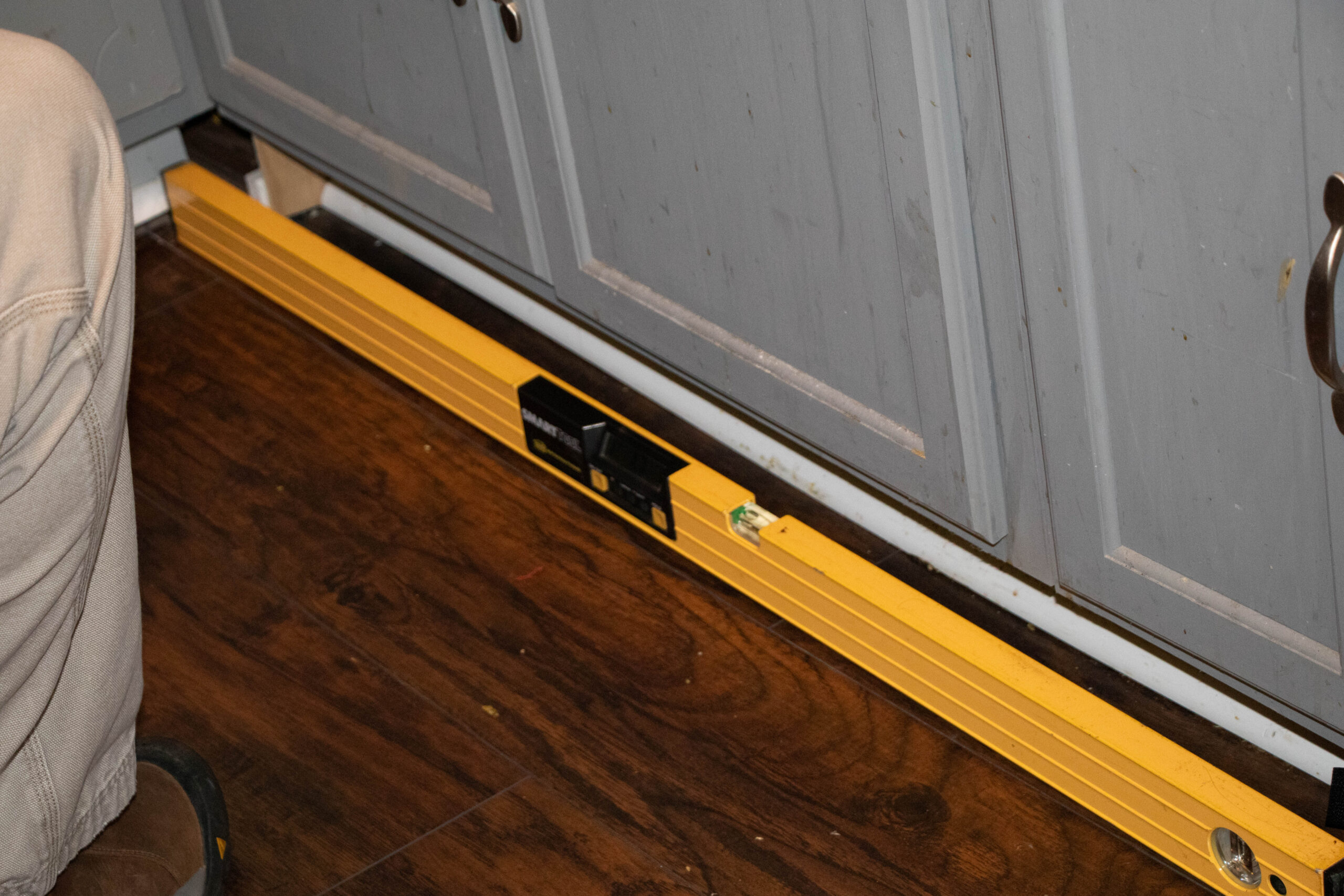
Floors can slope over time due to excess crawlspace moisture from poor ventilation if the IRC’s ventilation minimums are not met.
How Crawlspace Ventilation Affects Structural Integrity
Excess crawlspace moisture can lead to fungal growth, wood decay, termite and other wood-destroying organism problems, soft and distorted framing, buckled floors, and hanging and displaced insulation. While a sound vapor barrier is the most crucial factor in controlling crawlspace moisture, proper ventilation can also be important. During the hot and humid summer months, proper ventilation plays a key role in reducing humidity levels within a crawlspace environment.
But it’s a delicate balance; too much ventilation can increase humidity inside crawlspaces in the summer and lead to frozen pipes, cold floors, and increased energy use in the winter.
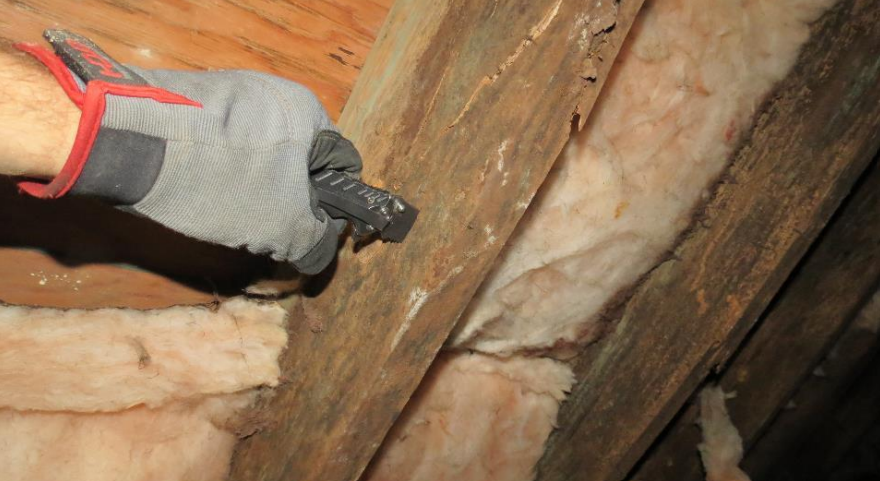
These floor joists became so rotted from crawlspace moisture that a pocketknife could fully penetrate them with minimal hand pressure.
Crawlspace Ventilation Requirements for Residential Buildings
To help ensure this balance is maintained, the IRC outlines requirements for crawlspace ventilation, with and without vapor barriers. The code sets a minimum net area of ventilation openings relative to the square footage of under-floor space and states that one ventilation opening shall be located within 3 feet of each building corner.
However, the IRC allows for the total area of these ventilation openings to be reduced when an approved and complete vapor retarder is installed. The code also says that ventilation openings are not required when a crawlspace with an earthen floor is covered with a Class I vapor retarder that extends a minimum of 6 inches up the foundation walls, joints are overlapped, and there is a mechanical exhaust system or conditioned air supply. An engineer inspecting claimed damage to crawlspaces can measure to ensure these requirements are met.
Why Attic Ventilation Matters
Attic ventilation should not be neglected either. Proper ventilation here plays a role in the prevention of ice dams and the reduction of wintertime condensation that may otherwise contribute to mold growth.
In warmer parts of the country and during summer months, inadequate air movement in an attic can also cause shingles to deteriorate more rapidly than they otherwise would. In light of these potential damages, the IRC provides minimum attic ventilation requirements in addition to its requirements for crawlspace ventilation.
The IRC on Attic Ventilation
The IRC’s minimums for attic ventilation openings and distribution are based on the square footage of the house and the presence of a vapor barrier. The code also specifies that ventilation openings must directly access the outdoor air and include safeguards against creatures like birds, rodents, and snakes.
Based on IRC’s requirements and best building practices, Donan’s forensic engineers advise that the most effective attic ventilation strategy divides the ventilation area equally between soffits, or the roof edge and the ridge, or roof peak. Proper installation of soffit ventilation permits air to enter the attic while safeguarding the insulation. Installing baffles can help prevent any blockage of the soffit vents. Powered vents, passive vents, or turbine vents can be used in lieu of or in addition to passive ventilation to ensure proper airflow through an attic.

This diagram depicts an attic ventilation system that equally allocates ventilation area between the soffits and the ridge.
Determining the Underlying Cause of Loss
When policyholders come to you with claims of damage to their flooring or mold in their attics, make sure you have a forensic engineering partner who understands minimum ventilation requirements and best practices so that you can get to the heart of the issue. Without addressing the underlying problem, you risk even larger claims down the line.
Donan’s engineering team, a part of Alpine Intel, delivers actionable intelligence and conclusive insights detailing the cause of loss for any property concern or scope of damage. Submit an assignment for your next structural claim to experience their detailed assessment process for yourself.

Don’t miss insurance-focused resources and webinars about property, perils, and trends impacting claims nationwide by signing up for The Savvy Adjuster Newsletter.

Be sure to also tune in to The Savvy Adjuster Podcast to hear more from the experts themselves.
Alpine Intel’s content is meant to inform and educate readers using general terms and descriptions. They do not replace expert evaluations that determine facts and details related to each unique claim.
Related Resources
How Extreme Heat May Affect HVAC Equipment Guide
Learn why HVAC claims may increase in summer, common equipment damages that may be exacerbated by heat, and facts that might help you settle based on an accurate cause of loss.
5 Ways Improper Ventilation Can Cause Fires
Proper ventilation is an important part of fire prevention. Consider if improper ventilation from these causes could have impacted your fire claim.

It’s OK To Vent: What Adjusters Should Know About Commercial Kitchen Ventilation
Adjusters should know about this equipment because when it operates correctly, the system controls the kitchen’s temperature, humidity, and airflow, and prevents smoke and fire incidents and associated claims.