
How Can Straight-Line Winds Contribute to Tree-Related Property Damage?

Key Takeaways:
In this article, you’ll learn:
- How severe winds can lead to tree-related property damage
- The best approach for having fallen trees or tree debris removed from a property
- Why an engineering assessment could be helpful following the removal
Straight-line winds regularly accompany intense storms and, in some cases, are a precursor to trees damaging property. In 2025 alone, more than 17,000 severe wind events were recorded nationwide.
When extreme weather occurs, adjusters should know what type of damage to expect and have a plan in place should trees, limbs, or tree debris impact or prevent access to residential or commercial buildings.
How Straight-Line Winds Can Cause Trees or Limbs To Fall
Downbursts create an intense downdraft that cause straight-line winds and accompany a thunderstorm but don’t have a rotation. They can cause tree limbs to snap, split tree trunks, or down entire trees. Just last year, a local news outlet in Minnesota reported that these types of winds exceeded 100 mph, ripping through town, taking out trees, and damaging several structures.
Winds can fell a tree when its center of gravity shifts from its supporting base. The wind’s velocity, acceleration, and throw weight (mass of the air and its contents) factor into the extent of damage a tree might incur. Constant changes in windspeed—and how long wind maintains a certain speed—mean trees that can’t hold up to ebbs and flows in pressure may ultimately lose limbs or completely topple.
Winds can fell a tree when its center of gravity shifts from its supporting base. The wind load’s velocity, acceleration, and throw weight (mass of the air and its contents) factor into the extent of damage a tree might incur. Constant changes in windspeed—and how long wind maintains a certain speed-mean trees that can’t hold up to ebbs and flows in pressure may ultimately lose limbs or completely topple.
A tree’s age and health at the onset of the weather event also play a role. Mature trees are more likely to experience windthrow (the term for trees being uprooted and subsequently blown over or falling down) because they have more mass above ground than in the roots, according to the Mississippi State University Extension.
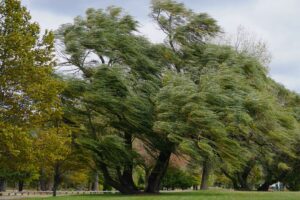
Tree health, age, and the severity of weather events, including those that have straight-line winds, can influence whether a tree will fall or remain upright.
Some tree types, so long as they have strong root systems, are better equipped to withstand high windspeeds than others.
Still, straight-line winds may be strong enough to take down entire trees, causing them to impact homes, buildings, vehicles, or anything else in their path.
When Straight-Line Winds Cause Trees To Fall on Property
There are several ways trees that fail to withstand straight-line winds could impact property and wind up in claims.
A chain reaction that starts with wind knocking down power lines might result in a tree falling on a road or getting caught in the wires and falling onto a property. A tree on a policyholder’s property, or a nearby property, may also fall directly on their home or business; a driveway; or other structures such as a shed, pool, detached garage, or fence.
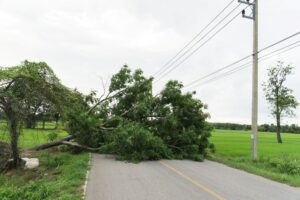
Straight-line winds may cause a mature tree to fall and impact utility lines.
Homeowners insurance policies may provide coverage, depending on the policy terms, conditions, exclusions, and limits, when lightning, wind, or another weather-related peril causes the tree-related damage. In these situations, insurance carriers should immediately involve their tree care partner, who will triage claims by “emergency” and “non-emergency” determination. Definitions might vary by provider, but claims in which a home is impacted or roadway access is hindered tend to receive higher priority.
The tree care provider will determine the scope of damage and size of the tree so they know which equipment and how much labor is needed for removal. In emergency situations, policies also likely cover protective measures like tarping so the removal process can begin as soon as possible without delaying assessment of the structure itself.
Property Assessments After Straight-Line Winds Cause Tree-Related Damage
Once the tree care partner has removed the tree, limbs, or tree debris from a property or structure, adjusters can request that a licensed engineer conduct a thorough assessment. This can help determine if all damage reported in a claim was due to the tree falling or something else, and the extent of loss to the structure.
Engineers will assess both internal and external visible damage to the structure, with the understanding that the energy imparted into the structure can be determined by the size and shape of the tree, its distance from the structure, the angle at which it struck the structure, and if the tree hit other objects on its path to the structure. The point of impact has the most force applied to it but isn’t the only area where damage may occur. Elements such as wall framing can distribute the tree’s impact throughout the structure, possibly leading to foundation or framing damage. Trees could also cause vibration damage near the point of impact.
At the same time, engineers will look for collateral indicators of straight-line winds. Items such as metal trim wrap, vinyl siding, or antennas are more vulnerable to wind-related damage because they’re often not securely attached to a structure. When identified as damaged, displaced, or detached, these elements could substantiate the presence and direction of strong winds when combined with weather data and local damage reports.
Straight-Line Winds Call for Service Provider Collaboration
For the most accurate determination on tree-related claims that involve straight-line winds, insurance carriers will want to involve multiple parties.
First, a tree care partner can safely and swiftly extract the trees, limbs, or tree debris while not further damaging the structure that was impacted or other areas of the property.
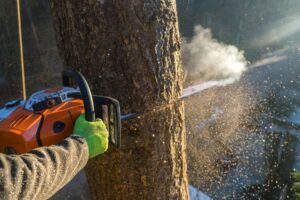
Insurance professionals can call on their tree care partner to remove trees, limbs, and debris that have fallen on, or prevent access to, a property.
Then, a licensed engineer would determine the full extent of the damage, delivering this information in a detailed report that combines engineering concepts with weather data.
Seeking this support from multiple experts ensures that insurance professionals have trusted and objective analyses built into their claims resolution process.
As a respected industry leader, Alpine Intel is dedicated to helping customers reach peak performance throughout the policy life cycle, or in this case, from tree removal to property assessment. HMI, a nationwide provider of outdoor property claim support in Alpine Intel’s suite of services, specializes in emergency tree removal, tree removal invoice reviews, and disaster response solutions for insurance professionals and organizations nationwide.
Meanwhile, Donan Engineering leverages the latest in technology and decades of experience to provide forensic engineering investigations with fast cycle times and exceptional reports that answer complex and challenging questions about property loss. To partner with HMI or Donan, submit an assignment today.

Don’t miss insurance-focused resources and webinars about property, perils, and trends impacting claims nationwide by signing up for The Savvy Adjuster Newsletter.

Be sure to also tune in to The Savvy Adjuster Podcast to hear more from the experts themselves.
Alpine Intel’s content is meant to inform and educate readers using general terms and descriptions. They do not replace expert evaluations that determine facts and details related to each unique claim.
Related Resources
Winter Property Damage eBook for Adjusters
Download the eBook to learn about losses linked to cold weather and prepare for winter claims involving HVAC equipment, structures, and fires.

Water Damage in Property Loss Claims Guide
Water damage is a frequently claimed peril. Download this guide to learn more about water losses to HVAC systems and electronics, including critical data, causes, and affected items.
Hail-Related Property Damage Claims eBook
Learn tips about hail damage, or what might look like it, when policyholders report hail impacts to roofs, structures, HVAC systems, outdoor equipment, and more.