
Dehumidifier Fire Losses: Making Informed Subrogation Decisions

Key Takeaways
This resource for insurance and legal professionals covers:
- Dehumidifier fire risks
- Two common failure modes that may be associated with manufacturing defects
- How determining the root cause of a dehumidifier fire can help ensure subrogation opportunities are not overlooked
Dehumidifier recalls citing risks of overheating, smoking, and igniting are not new, but they remain highly relevant in fire claims. While the Consumer Product Safety Commission (CPSC) first issued dehumidifier recalls more than two decades ago, major recalls have continued as recently as 2023—and many policyholders may still be unaware of these ongoing safety concerns.
That’s why product failure testing is critical when a dehumidifier is identified as the most plausible origin of a fire. Such testing can help determine whether a manufacturing defect played a role, equipping insurance and legal professionals with the information needed to make subrogation decisions.
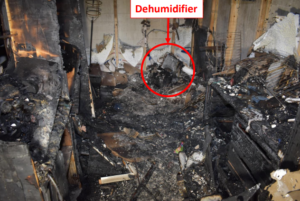
A dehumidifier at a fire scene does not, by itself, establish the item as the cause. However, when evidence suggests it may have contributed to the loss, further investigation is warranted to evaluate subrogation potential.
Dehumidifier Operation and Where Things Can Go Wrong
Dehumidifiers remove moisture by drawing in air and passing it over cold evaporator coils, where water condenses and collects in a bucket. The refrigerant then carries heat to the condenser coils, slightly reheating the dried air before releasing it back into the room.
At the core of this process is the compressor, which circulates the refrigerant by compressing and expanding it. To prevent overheating, compressors are equipped with a thermal protector, intended to interrupt the electrical current when temperatures exceed safe limits. However, many factors can cause this device to malfunction and create conditions that may lead to overheating and fire, including manufacturing defects.
Thermal Protector Failures That Risk Dehumidifier Fires
The thermal protector has a bi-metallic disc that deforms with a change in temperature. This deformation opens and closes the electrical contacts (or terminals), maintaining or cutting power to the compressor.
If manufactured or assembled improperly, the thermal protector can separate from the top surface of the compressor. This separation can prevent the device from detecting excessive internal heat because it only senses surface temperatures. As a result, the compressor may continue operating unchecked, eventually overheating to the point of ignition. Fires can spread to nearby combustible materials, causing varying degrees of property damage.
Internal failures in thermal protectors may also result from a manufacturing defect. Premature wear on the electrical contacts can cause them to begin to arc or weld together. When this happens, the thermal protector may no longer open as intended, causing the compressor to continue running, overheat, and potentially ignite.
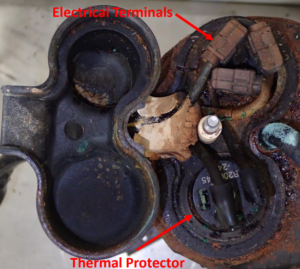
The thermal protector, shown here alongside the electrical terminals, is designed to prevent the dehumidifier compressor from overheating. However, if improperly manufactured, it can malfunction and pose a fire hazard.
Determining the Root Cause of Failure for Subrogation Decisions
Pursuing subrogation after a dehumidifier fire may enable insurance or legal professionals to hold the manufacturer responsible for the loss, recoup costs, and make the insured whole.
Science-based product failure testing is key to identifying the root cause when making these decisions. Knowing recalls exist is not enough to prove that a manufacturing defect was tied to a specific loss.
Fortunately, experienced Professional Engineers can examine dehumidifiers to determine how and why failures occurred.
Specific indicators these experts look for include, but aren’t limited to:
- Melting or welding of the thermal protector contacts
- Melting of compressor terminals or attached electrical connectors
- Arcing on power conductors routed to the compressor
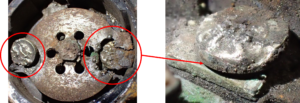
Professional Engineers can study the dehumidifier compressor to determine if a recalled failure mode was the cause. In this instance, melted and welded thermal protectors suggest this possibility.
A coordinated investigative effort is often required for dehumidifier fire claims and other fire losses that may be linked to a product failure. This is the approach Component Testing Laboratories (CTL) can provide by working with National Fire Experts (NFE)—both part of Alpine Intel’s suite of services. NFE can conduct origin and cause investigations to determine whether a dehumidifier caused or contributed to the fire. If it did, CTL and its in-house shipping service, Loss Logistics, can facilitate the secure transport, testing, and storage of the unit, maintaining comprehensive evidence tracking through a documented, single-entity chain of custody. Insights from CTL’s Professional Engineers make it possible for clients to confidently determine whether subrogation is the next appropriate step.
Experience NFE’s origin and cause investigations and CTL’s product failure expertise firsthand. Submit an assignment today.

Don’t miss insurance-focused resources and webinars about property, perils, and trends impacting claims nationwide by signing up for The Savvy Adjuster Newsletter.

Be sure to also tune in to The Savvy Adjuster Podcast to hear more from the experts themselves.
Alpine Intel’s content is meant to inform and educate readers using general terms and descriptions. They do not replace expert evaluations that determine facts and details related to each unique claim.
Related Resources
Your Guide to Investigating Manufacturing and Industrial Fire Losses
Learn about common factors and challenges in industrial fire losses and read about the benefits of using certified investigators with this guide.
Tackling Large Loss Fire Claims With Subrogation Potential eBook
Learn how a dedicated large loss response team helps preserve evidence, determine origin and cause, and support potential subrogation efforts after large loss fires.
5 Mistakes That Destroy Fire Evidence Before Subrogation
Pursuing subrogation post-fire requires carefully preserved evidence. Read about five common evidence-handling errors and how to avoid them.