Corrosion Types That Could Signal Subrogation Potential

Corrosion is a common cause of failure in dishwashers, water heaters, washing machines, and brass fittings—often resulting in expensive water damage for policyholders. But when you encounter a claim that could have been caused by corrosion, it’s worth pausing to investigate what’s really behind the loss, as it might reveal subrogation potential.
This is where expert component and product failure testing becomes essential to provide insights into the corrosion and why it occurred. Learn more about three major types of corrosion and how they might be related to manufacturers’ defects.
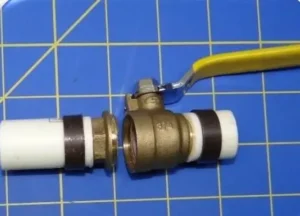
Corrosion can contribute to failure in various household plumbing components, including brass fittings commonly found on water supply lines.
Galvanic Corrosion
Galvanic corrosion is a common culprit behind the failure of appliances like dishwashers and water heaters. This process occurs when two dissimilar metals come into direct contact in the presence of an electrolyte, such as water. Under these conditions, the less noble metal corrodes more quickly, often leading to functional issues or leaks.
Take dishwashers, for instance. Inside the appliance, the heating element sometimes has a brass assembly flange. Here, the brass flange plays the role of the anode (the less noble metal), the steel sheath acts as the cathode (the more noble metal), and water serves as the electrolyte. Over time, the brass flange deteriorates, potentially causing a leak beneath the dishwasher.
This kind of failure stems directly from the materials used in the heating element’s design. To combat this, many manufacturers have switched to using stainless steel flanges.
A manufacturer’s defect can also lead to corrosion in some tank-style water heaters. The tank’s interior is typically coated with vitreous enamel to safeguard it against corrosion. However, if this protective coating fails to cover the entire surface due to a manufacturing defect, the system becomes vulnerable.
Without complete coverage, the tank must rely heavily on the anode rod to prevent galvanic corrosion. The anode rod, designed to corrode in place of the tank, takes on the role of protecting any exposed areas. Over time, this increased reliance can accelerate wear on the anode rod, potentially compromising the tank’s integrity and leading to premature failure.
Stress Corrosion Cracking
Next up is a type of corrosion that often affects brass fittings used in plumbing systems—Stress Corrosion Cracking (SCC). This is a process that causes cracks in a material that is both exposed to a corrosive environment and under tensile stress. SCC can lead to a sudden and unexpected failure of a material, even if it is normally ductile.
Brass, a copper-zinc alloy, is widely used in plumbing, but it must meet strict codes to resist SCC. When manufacturers fail to adhere to these standards, brass components can fail, leading to costly water damage.
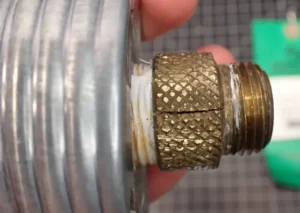
This image shows the detrimental effects of SCC on a brass coupling up-close.
Product failure testing helps identify SCC and assess whether manufacturer’s defects caused the failure. This information enables insurance professionals to decide if pursuing subrogation is warranted, promoting manufacturer accountability and reducing future risks.
Stray-Current Corrosion
This last failure mode, stray-current corrosion, is actually an acceleration of galvanic corrosion that occurs when a current flows along paths other than its intended circuit. This can happen if an electrical system is designed, installed, or maintained improperly and can damage appliances and metal structures.
This sometimes occurs in washing machines. The thermistor, which measures the temperature within this appliance, is connected to an electrical circuit. If the thermistor housing is poorly molded, residual water within the fitting can conduct stray direct current to the machine’s grounded water hose fitting.
This unintended current accelerates galvanic corrosion, weakening the supply hose fitting and leading to fractures, leaks, or even potential shock hazards. It’s critical that manufacturers construct thermistor housing correctly to avoid this failure.
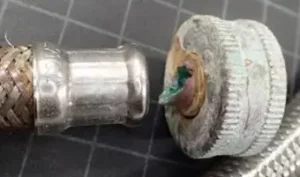
A stray current from the washing machine’s thermistor accelerated the corrosion of this water hose fitting.
How Do Corrosion Experts Identify Its Cause?
Identifying the cause of failure is the first step in any investigation into subrogation potential, and it takes expertise and the right tools. While the Professional Engineers at Component Testing Laboratories (CTL), part of Alpine Intel’s suite of services, don’t weigh in on subrogation, they can help inform your decisions by providing their extensive knowledge and skills for product failure investigations.
And among other things, they are corrosion experts. Depending on your specific needs, they can begin with non-destructive tests to evaluate any of the appliances and components discussed here.
CTL’s engineers can also employ Energy Dispersive Spectrometry (EDS) to analyze the elemental composition of materials, such as metals, ceramics, and coatings. This helps determine whether the properties of the material selected or formulated by the manufacturer contributed to corrosion or another type of failure. For conclusive insights into a product failure, submit an assignment.

Don’t miss insurance-focused resources and webinars about property, perils, and trends impacting claims nationwide by signing up for The Savvy Adjuster Newsletter.

Be sure to also tune in to The Savvy Adjuster Podcast to hear more from the experts themselves.
Alpine Intel’s content is meant to inform and educate readers using general terms and descriptions. They do not replace expert evaluations that determine facts and details related to each unique claim.
Related Resources

Exploring Subrogation Potential: Plumbing and Appliance Failures
Use this interactive guide to learn about appliance and plumbing failures identified at Component Testing Laboratories that may warrant subrogation.
Tackling Large Loss Fire Claims With Subrogation Potential eBook
Learn how a dedicated large loss response team helps preserve evidence, determine origin and cause, and support potential subrogation efforts after large loss fires.

Identifying Subrogation Potential: A Field Adjuster’s Checklist for When To Investigate a Product Failure
Subrogation starts with identifying evidence onsite. This one-page guide equips field adjusters with essential tips for considering subrogation potential.